

Shasta Blue
icaricia shasta
The Shasta Blue (Icaricia shasta) is a captivating small butterfly, renowned for its striking iridescent blue wings and its affinity for high-altitude environments. This species plays a vital role in its subalpine ecosystems as a pollinator and an herbivore in its larval stage. Its life cycle is intrinsically linked to specific host plants, primarily various species of Lupinus, making it a specialist within its mountainous habitat. The Shasta Blue's short adult flight period and preference for open, sunny meadows make it a cherished sight for naturalists and hikers who venture into its elevated home during the summer months.
生息地: Found in high-altitude meadows, subalpine slopes, and open montane areas, often where its host plant, Lupinus, is abundant.
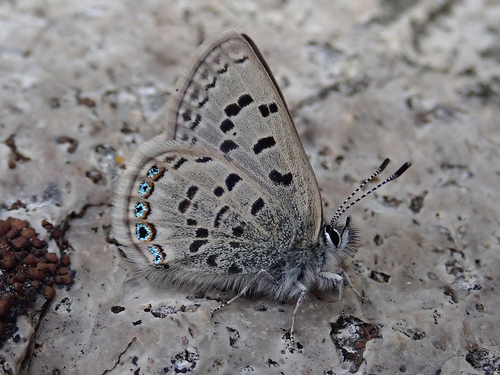
The Shasta Blue is a diminutive butterfly, typically exhibiting a wingspan of 2 to 3 cm. Males are easily identified by the brilliant, iridescent blue on the dorsal surface of their wings, often with a narrow black margin and a fringe of white. Females are usually a duller blue, sometimes with a brownish wash, and may have a series of dark spots near the hindwing margin. The ventral side of both sexes is grayish-brown, adorned with a scattering of black spots outlined in white, and a row of submarginal black spots on the hindwing, which are often capped with orange crescents, a key identifier.
カテゴリ
昆虫レア度
Common
危険度
1/5 · 非常に低い
スナップ
最初にスナップしよう!
Shasta Blue butterflies typically have only one generation per year, emerging for a short flight period in mid-summer.
The scientific name 'shasta' refers to Mount Shasta in California, one of the iconic locations where this butterfly can be found.
The undersides of their wings, with their distinct black spots and orange crescents, are crucial for species identification in the field.
Their larvae are often tended by ants, which protect them from predators in exchange for a sweet honeydew secretion.
The Shasta Blue larvae exclusively feed on the leaves of various Lupinus species. This tight ecological bond makes the butterfly highly dependent on the presence and health of these specific plants.
This species is well-adapted to the harsh conditions of high-altitude environments, including cooler temperatures and strong winds, thriving in elevations where many other butterfly species cannot.
Like many Lycaenidae, Shasta Blue larvae secrete a sugary substance that attracts ants. The ants protect the larvae from predators and parasites in exchange for this sweet reward.
Adult Shasta Blue butterflies feed on nectar from a variety of wildflowers, while their larvae are specialist herbivores, exclusively consuming the leaves of specific Lupinus species.
年齢による違い: Larvae feed on Lupinus leaves, while adults exclusively consume nectar.
Lupinus spp.
The primary food source for Shasta Blue larvae.
Formica spp.
Ants provide protection to Shasta Blue larvae from predators in exchange for sugary secretions.
Erigeron peregrinus
Adult Shasta Blue butterflies contribute to the pollination of various high-altitude wildflowers while feeding on their nectar.
Sialia currucoides
Various species of birds in the habitat may prey on adult Shasta Blue butterflies.
このオブジェクトにはまだ特徴バッジが割り当てられていません。
まだ別名はありません。
テーマが追加されると、このオブジェクトのコレクションがここに表示されます。
危険度
1/5 · 非常に低い
まだ特別な安全上の注意はありません。
Shasta Blueを識別する最も簡単な方法は、Snappit自然識別アプリを使用することです。
1-2 cm
2-3 cm
0.0001-0.0002 kg
0 年
Adult Shasta Blue butterflies feed on nectar from a variety of wildflowers, while their larvae are specialist herbivores, exclusively consuming the leaves of specific Lupinus species.
Found in high-altitude meadows, subalpine slopes, and open montane areas, often where its host plant, Lupinus, is abundant.
Foraging
ズームインしてクラスターを分割し、このオブジェクトが撮影された場所を探索しましょう。
新しい観察が追加されると、ここに最近のスナップが表示されます。











.jpg&width=800)



