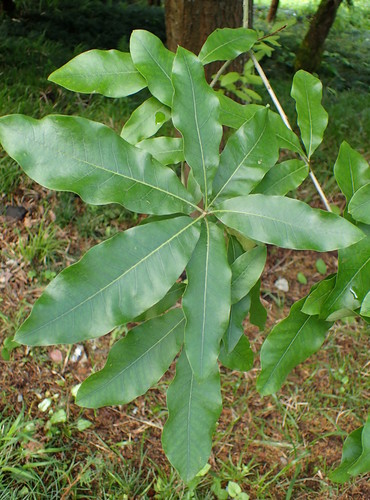


Shingle Oak
quercus imbricaria
The Shingle Oak is a distinctive, medium-sized deciduous tree native to the central and eastern United States. Unlike most of its oak relatives, which are renowned for their deeply lobed leaves, the Shingle Oak boasts smooth, unlobed foliage that more closely resembles a laurel tree. It belongs to the red oak group and is a resilient species that thrives in a variety of environments, from moist stream banks to drier upland slopes. Historically, this tree played a vital role for early American pioneers who discovered that its straight-grained wood could be easily split into durable roofing shingles. Today, its dense, symmetrical canopy and rich autumn colors make it an attractive shade tree in parks and large landscapes, while its acorns provide a crucial food source for a wide array of woodland wildlife.
生息地: Typically found in moist bottomlands and along streams, but also highly adaptable to drier upland slopes and woodland edges.
Quercus imbricaria typically reaches heights of 15 to 20 meters, developing a conical to rounded crown as it matures. The most identifying feature is its leaves: they are 10 to 15 centimeters long, narrow, completely smooth-edged, and lack the characteristic lobes of most oaks. The leaves are glossy dark green on top and slightly paler and hairy underneath, turning yellow to reddish-brown in the fall. Its bark is dark grayish-brown with shallow fissures and flat ridges. The acorns are relatively small, about 1.5 centimeters long, with a thin, bowl-shaped cup composed of appressed, slightly hairy scales that cover one-third to one-half of the nut.
カテゴリ
植物レア度
Common
危険度
1/5 · 非常に低い
スナップ
最初にスナップしよう!
Because it exhibits a trait called 'marcescence,' the Shingle Oak keeps many of its dead, rust-brown leaves attached to its branches all winter long.
The common name 'Shingle Oak' comes from the fact that pioneer settlers in the Midwest used its easily split wood to make roofing shingles.
Unlike most other oak species, which are famous for their heavily lobed leaves, the Shingle Oak has perfectly smooth, unlobed leaf edges.
This tree often retains its dead, brown leaves throughout the harsh winter months, providing excellent windbreaks and crucial winter shelter for woodland birds and small mammals.
The leaves and acorns contain high levels of tannins, which act as a chemical defense mechanism that discourages excessive herbivory from insects and foraging mammals.
The wood of this tree grows with a remarkably straight and uniform grain, allowing the wood to be effortlessly split into thin, flat boards.
As a photosynthetic plant, the Shingle Oak produces its own food by converting sunlight, water, and atmospheric carbon dioxide into essential sugars.
Sciurus carolinensis
Relies on the acorns as an important winter food source.
Odocoileus virginianus
Browses on the twigs and younger foliage during the winter.
Platycotis vittata
Utilizes the tree as a host plant, feeding on sap and laying eggs on its branches.
このオブジェクトにはまだ特徴バッジが割り当てられていません。
まだ別名はありません。
テーマが追加されると、このオブジェクトのコレクションがここに表示されます。
危険度
1/5 · 非常に低い
まだ特別な安全上の注意はありません。
Shingle Oakを識別する最も簡単な方法は、Snappit自然識別アプリを使用することです。
1500-2000 cm
100-200 年
As a photosynthetic plant, the Shingle Oak produces its own food by converting sunlight, water, and atmospheric carbon dioxide into essential sugars.
Typically found in moist bottomlands and along streams, but also highly adaptable to drier upland slopes and woodland edges.
Photosynthesis
ズームインしてクラスターを分割し、このオブジェクトが撮影された場所を探索しましょう。
新しい観察が追加されると、ここに最近のスナップが表示されます。















