

Sierra Columbine
aquilegia pubescens
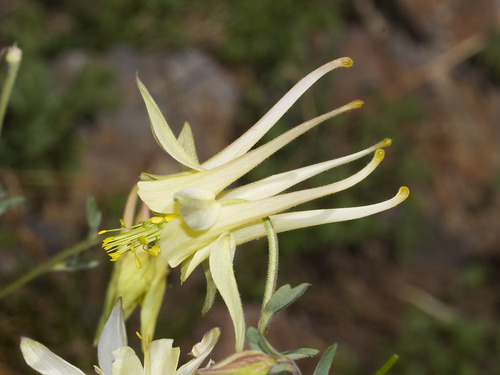
The Sierra Columbine (Aquilegia pubescens) is a stunning perennial wildflower endemic to the high-altitude rocky slopes of California's Sierra Nevada. Rising elegantly above alpine talus and rock crevices, this plant is a marvel of adaptation to harsh, cold environments. Its large, creamy-yellow to pastel-pink blossoms face upward toward the sky, which is a distinct departure from the downward-nodding habit of many other columbine species. It brings a delicate beauty to rugged granite landscapes, blooming during the brief alpine summer. Highly sought after by hikers and botanists alike, this species represents the fragile yet resilient nature of alpine flora.
生息地: Found primarily in subalpine and alpine talus slopes, rocky crevices, and moist alpine meadows at elevations between 2,700 and 4,000 meters.
This plant features striking, cream-colored, pale yellow, or light pink flowers that measure about 3 to 5 cm across and face upward. Each blossom is characterized by five petal-like sepals and five true petals extending backward into long, slender nectar spurs that can reach up to 4 cm in length. The foliage consists of delicate, bluish-green, compound leaves divided into rounded leaflets, forming a basal clump from which the erect, sticky flower stems emerge, typically reaching heights of 20 to 60 cm.
カテゴリ
植物レア度
Common
危険度
1/5 · 非常に低い
スナップ
最初にスナップしよう!
Contrary to the typical hanging posture of other columbines, the Sierra Columbine holds its flowers face-up, specifically adapted to entice hovering hawkmoths.
It thrives at extreme elevations, often found growing directly out of seemingly solid granite cracks up to 13,000 feet (4,000 meters) above sea level.
Where its range overlaps with the red Crimson Columbine, they hybridize to create a spectrum of beautiful cream, yellow, pink, and orange flowers.
Unlike nodding columbines, its flowers face skyward, making them highly visible to flying hawkmoths in open alpine environments.
Possesses exceptionally long spurs that hide nectar deep within, ensuring only specialized pollinators with long tongues can access it.
Features a low-growing basal rosette and deep root system that anchors the plant in rocky crevices, protecting it from fierce winds and freezing temperatures.
Generates its own energy through photosynthesis using sunlight, water, and carbon dioxide, while absorbing essential minerals from thin alpine soils.
Hyles lineata
The hawkmoth feeds on the nectar at twilight, transferring pollen between these high-altitude flowers.
Aquilegia formosa
Readily hybridizes with this species at transition zones between lower and higher elevations, producing intermediate pink-hued flowers.
Bombus vosnesenskii
Acts as a nectar robber by chewing holes in the bases of the long spurs to steal nectar without pollinating the flower.
このオブジェクトにはまだ特徴バッジが割り当てられていません。
まだ別名はありません。
テーマが追加されると、このオブジェクトのコレクションがここに表示されます。
危険度
1/5 · 非常に低い
まだ特別な安全上の注意はありません。
Sierra Columbineを識別する最も簡単な方法は、Snappit自然識別アプリを使用することです。
20-60 cm
3-8 年
Generates its own energy through photosynthesis using sunlight, water, and carbon dioxide, while absorbing essential minerals from thin alpine soils.
Found primarily in subalpine and alpine talus slopes, rocky crevices, and moist alpine meadows at elevations between 2,700 and 4,000 meters.
ズームインしてクラスターを分割し、このオブジェクトが撮影された場所を探索しましょう。
新しい観察が追加されると、ここに最近のスナップが表示されます。








_BHL23630341.jpg&width=800)










_Geranium_sanguineum_-_Flower_and_leaf_-_Les_Martels%2C_Giroussens_Tarn.jpg&width=800)