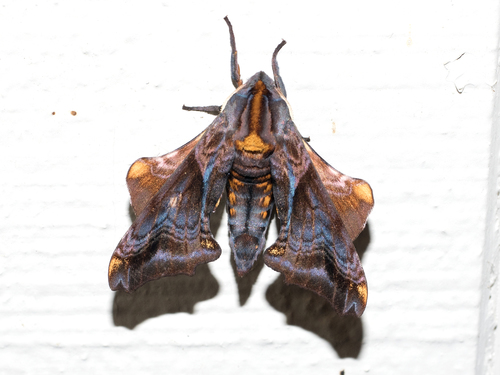


Small-Eyed Sphinx
paonias myops
The Small-Eyed Sphinx (Paonias myops) is a fascinating member of the hawkmoth family, Sphingidae, native to North America. Known for its remarkable cryptic camouflage, this moth spends its resting hours mimicking a dead leaf to avoid detection by predators. It belongs to a group of moths where the adults possess reduced mouthparts and do not feed, relying entirely on the energy reserves they accumulated as caterpillars. This makes their adult life brief but highly focused on reproduction.
生息地: Found in deciduous woodlands, forest edges, suburban gardens, and orchards where host plants from the rose family are abundant.
This medium-sized moth features scalloped forewings colored in rich shades of chocolate brown, purplish-gray, and yellow-brown. When resting, it folds these wings to look like a dry leaf. However, when threatened, it parts them to reveal vibrant yellow hindwings marked with a striking, blue-centered black eyespot (ocellus) near the lower margin. It has a wingspan ranging from 4.5 to 7.5 centimeters, and its thorax has a distinct dark, velvety central stripe.
カテゴリ
昆虫レア度
Common
危険度
1/5 · 非常に低い
スナップ
最初にスナップしよう!
Because adult Small-Eyed Sphinx moths cannot eat, their entire adult life lasts only about a week, dedicated solely to finding a mate.
The caterpillars have a small, lime-green horn on their rear end, a signature trait of the hawkmoth family commonly called hornworms.
Their scientific name 'myops' comes from Greek, meaning 'near-sighted' or 'closed-eyes', referring to the small size of their hindwing eyespots compared to related species.
Flashes its hidden, bright yellow hindwings and realistic blue-and-black eyespots to frighten potential predators like birds.
Mimics the shape, color, and texture of a dead, dry leaf when resting with its wings folded.
Survives entirely without feeding as an adult, efficiently utilizing lipids stored during its highly voracious caterpillar stage.
The larvae feed extensively on the leaves of deciduous trees and shrubs, particularly cherries and plums, while the adult moths do not feed at all.
年齢による違い: Larvae consume large quantities of foliage to store energy, whereas adults have non-functional mouthparts and do not consume food.
Prunus serotina
The larvae rely on this tree as their primary food source, feeding heavily on its foliage.
Cyanocitta cristata
Active songbirds opportunistically hunt both the adult moths and their large caterpillars.
Cotesia congregata
A parasitoid wasp that lays its eggs inside the living caterpillar, eventually killing the host.
このオブジェクトにはまだ特徴バッジが割り当てられていません。
まだ別名はありません。
テーマが追加されると、このオブジェクトのコレクションがここに表示されます。
危険度
1/5 · 非常に低い
まだ特別な安全上の注意はありません。
Small-Eyed Sphinxを識別する最も簡単な方法は、Snappit自然識別アプリを使用することです。
2-4 cm
4-8 cm
0.0005-0.002 kg
1 年
18 km/h
The larvae feed extensively on the leaves of deciduous trees and shrubs, particularly cherries and plums, while the adult moths do not feed at all.
Found in deciduous woodlands, forest edges, suburban gardens, and orchards where host plants from the rose family are abundant.
ズームインしてクラスターを分割し、このオブジェクトが撮影された場所を探索しましょう。
新しい観察が追加されると、ここに最近のスナップが表示されます。











.jpg&width=800)

