

Smaller Parasa Moth
parasa chloris
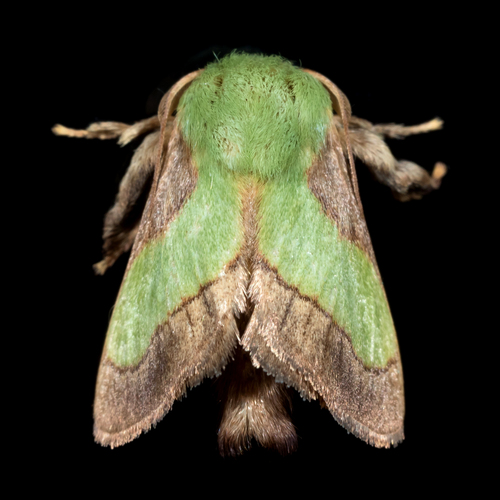
The Smaller Parasa Moth (Parasa chloris) is an enchanting member of the slug moth family, renowned for its dramatic dual identity. As an adult, this moth displays a serene, moss-green and chestnut-brown coloration that provides superb camouflage against leafy backdrops. However, it is the larval stage that often steals the spotlight; the caterpillar is a vibrant, slug-like creature adorned with colorful warning patterns and formidable, venom-filled stinging spines. Widely distributed across eastern North America, this species inhabits deciduous forests and orchards, where its larvae feed on a wide variety of woody plants. While gardeners and hikers may dread a brush with the caterpillar's painful defenses, the moth remains a captivating example of nature's defense strategies and ecological complexity.
生息地: Typically found in deciduous woodlands, mixed forests, orchards, and suburban gardens across eastern North America.
The adult Smaller Parasa Moth is easily identified by its striking forewings, which feature a broad, vibrant pea-green central band flanked by a rich, dark brown base and a thick brown outer margin. This green band has a smooth, curved border that distinguishes it from similar species. The wingspan ranges from 2.0 to 3.0 centimeters, and the body is stout and densely furry with greenish-brown hairs. In contrast, the larva is a flattened, slug-like caterpillar lacking prolegs, brilliantly colored in lime green with red, yellow, or purple stripes along its back, and ringed with bristling tubercles containing urticating spines.
カテゴリ
昆虫レア度
Common
危険度
1/5 · 非常に低い
スナップ
最初にスナップしよう!
An encounter with the caterpillar's stinging spines can cause a painful, burning rash and inflammation that can last for several days, comparable to a wasp sting.
The adult moth's green coloration is quite unusual among North American moths, providing highly specialized camouflage for life in the forest canopy.
The caterpillar of this moth does not have typical caterpillar prolegs; instead, it glides on a sticky, slug-like sole, which is why the family is known as slug moths.
To pupate, the caterpillar spins a remarkably tough, brown, egg-shaped cocoon that resembles a small tree bud, protecting it through the winter.
The larval stage possesses sharp, hollow spines connected to poison glands that inject a painful toxin upon contact, deterring predators.
The adult moth's vibrant green forewings perfectly mimic fresh leaves, allowing it to rest invisibly on foliage during the day.
The caterpillar displays bright, high-contrast neon stripes and colorful tubercles to warn potential predators of its chemical defenses.
As larvae, they feed voraciously on the leaves of deciduous trees, while the short-lived adults have vestigial mouthparts and do not feed at all.
Quercus alba
The larvae use this plant as a primary host source, consuming its leaves for nutrition.
Cyanocitta cristata
Birds occasionally prey on the pupal cocoons or adult moths, though they carefully avoid the stinging caterpillars.
Cotesia congregata
This parasitoid wasp lays its eggs inside the caterpillar, which eventually kills the host as the wasp larvae grow.
このオブジェクトにはまだ特徴バッジが割り当てられていません。
まだ別名はありません。
テーマが追加されると、このオブジェクトのコレクションがここに表示されます。
危険度
1/5 · 非常に低い
まだ特別な安全上の注意はありません。
Smaller Parasa Mothを識別する最も簡単な方法は、Snappit自然識別アプリを使用することです。
1+ cm
2+ cm
0.0001+ kg
1+ 年
8 km/h
As larvae, they feed voraciously on the leaves of deciduous trees, while the short-lived adults have vestigial mouthparts and do not feed at all.
Typically found in deciduous woodlands, mixed forests, orchards, and suburban gardens across eastern North America.
ズームインしてクラスターを分割し、このオブジェクトが撮影された場所を探索しましょう。
新しい観察が追加されると、ここに最近のスナップが表示されます。