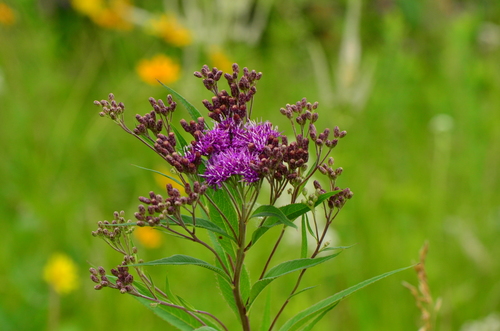


Smooth Ironweed
vernonia fasciculata
Smooth Ironweed is a robust and striking native North American perennial wildflower, famous for its vivid, intense purple blooms that emerge in late summer. Reaching heights of up to six feet, this resilient plant is a staple of wet prairies, sedge meadows, and river floodplains across the Midwestern United States. Its common name, ironweed, pays homage to its incredibly tough, fibrous stems, which successfully withstand strong prairie winds and discourage grazing animals. Gardeners and conservationists prize it for its ability to attract a wide diversity of pollinators, acting as an ecological anchor in tallgrass prairie restorations.
生息地: Typically found in moist to wet prairies, marshes, sedge meadows, and river floodplains.
This tall perennial stands upright on stiff, smooth, reddish-purple stems that are entirely hairless. Its lance-shaped leaves are arranged alternately, featuring sharply toothed margins and distinctive tiny pits on their hairless undersides. In late summer, the plant is topped by flat, dense clusters of bright magenta to deep purple flower heads, each composed entirely of disk florets with no rays, which eventually give way to rusty-brown seed heads.
カテゴリ
植物レア度
Common
危険度
1/5 · 非常に低い
スナップ
最初にスナップしよう!
Because livestock avoid its bitter taste, Smooth Ironweed often becomes dominant in overgrazed pastures, earning it a reputation as a stubborn weed among ranchers.
The common name 'Ironweed' refers not only to the tough, metallic-colored stems but also to the rusty-brown color of the seed heads in autumn.
The genus name Vernonia honors the English botanist William Vernon, who conducted extensive plant collections in Maryland during the late 17th century.
The exceptionally tough, fibrous stems allow the plant to remain upright in severe storms and high prairie winds.
Leaves contain bitter chemical compounds that make the plant unpalatable to cattle and deer, ensuring its survival in heavily grazed areas.
Blooms late in the season when many other flowers have faded, providing a critical nectar source for migrating butterflies.
As a photoautotrophic plant, Smooth Ironweed synthesizes its own food using sunlight, carbon dioxide, and water through the process of photosynthesis.
Danaus plexippus
Provides vital late-season nectar to migrating adults during their southern journey.
Papaipema impecuniosa
Larvae of this specialist moth bore into the stems of the plant to feed and pupate.
Melissodes dentiventris
Feeds heavily on the pollen and nectar, acting as an effective pollinator.
このオブジェクトにはまだ特徴バッジが割り当てられていません。
まだ別名はありません。
テーマが追加されると、このオブジェクトのコレクションがここに表示されます。
危険度
1/5 · 非常に低い
まだ特別な安全上の注意はありません。
Smooth Ironweedを識別する最も簡単な方法は、Snappit自然識別アプリを使用することです。
90-180 cm
3-10 年
As a photoautotrophic plant, Smooth Ironweed synthesizes its own food using sunlight, carbon dioxide, and water through the process of photosynthesis.
Typically found in moist to wet prairies, marshes, sedge meadows, and river floodplains.
ズームインしてクラスターを分割し、このオブジェクトが撮影された場所を探索しましょう。
新しい観察が追加されると、ここに最近のスナップが表示されます。








