

Smooth Phlox
phlox glaberrima
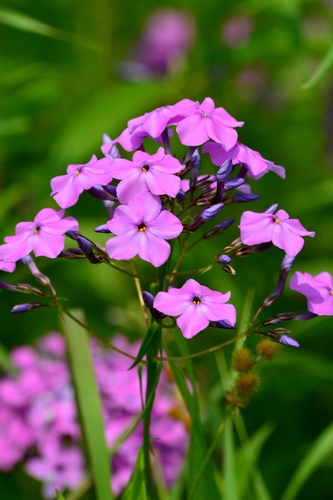
Smooth Phlox (Phlox glaberrima) is a vibrant and cherished wildflower native to the eastern and central United States. Renowned for its brilliant clusters of pink to purple flowers, it brings a splash of color to meadows, open woodlands, and prairies during the summer months. This perennial herb is an important component of its ecosystem, providing nectar for various pollinators and contributing to the aesthetic beauty of natural landscapes. Its relatively easy cultivation has also made it a popular choice for native plant gardens, where it thrives and adds a delicate elegance with minimal care.
生息地: Smooth Phlox is typically found in moist to wet prairies, open woods, meadows, stream banks, and savannas.
Smooth Phlox typically grows 30-90 cm (1-3 feet) tall, featuring slender, unbranched stems that are, as its name suggests, smooth and hairless. The leaves are opposite, lance-shaped, and also smooth, contributing to its sleek appearance. The star-like flowers, measuring about 2-3 cm across, bloom in dense, rounded clusters at the top of the stems. Petal color ranges from bright pink to magenta or lavender-purple, often with a darker eye, creating a striking visual contrast against its green foliage.
カテゴリ
植物レア度
Common
危険度
1/5 · 非常に低い
スナップ
最初にスナップしよう!
Historically, some Native American tribes used certain Phlox species for medicinal purposes, though specific uses for P. glaberrima are less documented.
It is a valuable native plant for rain gardens and moist border plantings, supporting local biodiversity and requiring minimal maintenance once established.
Smooth Phlox is distinguished from other Phlox species by its consistently hairless (glabrous) stems and leaves, a key identifier reflected in its scientific name 'glaberrima'.
The genus name 'Phlox' comes from the Greek word for 'flame,' possibly referring to the intense colors of some species or their brilliant mass blooming effect.
Its brightly colored, fragrant flowers act as a strong attractant for various pollinators, especially butterflies and long-tongued bees, facilitating efficient cross-pollination.
Adapted to thrive in consistently moist to wet soil conditions, allowing it to flourish in habitats like wet prairies and stream banks where many other plants might struggle.
Produces numerous seeds that readily self-sow, enabling it to establish and spread naturally within suitable environments, ensuring its persistence in the landscape.
As an autotrophic plant, Phlox glaberrima produces its own food through photosynthesis, converting sunlight, carbon dioxide, and water into sugars for energy and growth, while absorbing essential minerals from the soil.
Papilio glaucus
Nectar source for adult butterflies.
Bombus spp.
Nectar and pollen source for long-tongued bees.
Odocoileus virginianus
Leaves and stems may be browsed.
Glomeromycota spp.
Forms symbiotic relationships with fungi to enhance nutrient uptake.
このオブジェクトにはまだ特徴バッジが割り当てられていません。
まだ別名はありません。
テーマが追加されると、このオブジェクトのコレクションがここに表示されます。
危険度
1/5 · 非常に低い
まだ特別な安全上の注意はありません。
Smooth Phloxを識別する最も簡単な方法は、Snappit自然識別アプリを使用することです。
30-90 cm
0.01-0.1 kg
3-10 年
As an autotrophic plant, Phlox glaberrima produces its own food through photosynthesis, converting sunlight, carbon dioxide, and water into sugars for energy and growth, while absorbing essential minerals from the soil.
Smooth Phlox is typically found in moist to wet prairies, open woods, meadows, stream banks, and savannas.
Photosynthesis, Nutrient Absorption
50-500
ズームインしてクラスターを分割し、このオブジェクトが撮影された場所を探索しましょう。
新しい観察が追加されると、ここに最近のスナップが表示されます。




.jpg&width=800)