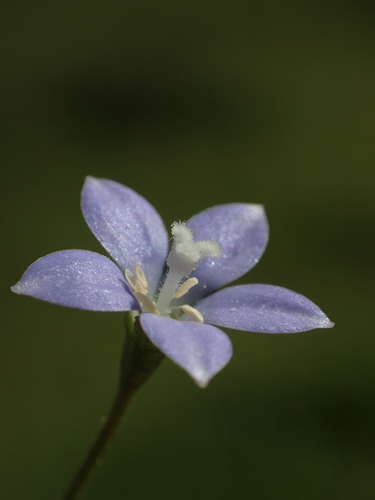


Southern Rockbell
wahlenbergia marginata
The Southern Rockbell (Wahlenbergia marginata) is a delicate, perennial herb native to East Asia, Australia, and New Zealand. Belonging to the bellflower family (Campanulaceae), this resilient plant is often found in disturbed soils, rocky outcrops, and grassy fields. Despite its fragile appearance, it is remarkably hardy, surviving in harsh, nutrient-poor conditions where other plants might struggle. It is widely recognized by its charming, bell-shaped blue-to-violet flowers that sway gently on thin, wiry stems, bringing a splash of color to barren grounds.
生息地: Found in open grassy areas, sandy coastlines, rocky slopes, and disturbed soils such as roadsides.
This slender herb typically grows between 10 to 60 cm tall, featuring erect, often branched, wiry stems. Its leaves are narrow, lance-shaped, and usually have wavy or finely serrated margins, especially near the base of the plant. The striking flowers are bell-shaped, measuring about 1 to 1.5 cm across, with five pointed petals that range in color from a pale sky blue to a deep violet, sometimes appearing almost white at the center.
カテゴリ
植物レア度
Common
危険度
1/5 · 非常に低い
スナップ
最初にスナップしよう!
In some regions, the plant is considered a harmless lawn weed because of its ability to thrive in mowed turf and pavement cracks.
Its flowers are highly sensitive to sunlight, opening wide during bright days and closing during overcast weather or at night.
The genus name Wahlenbergia honors Georg Wahlenberg, a famous Swedish botanist and professor.
Can withstand prolonged periods of dry conditions by reducing transpiration and utilizing its deep taproot system to access subterranean water.
Rapidly colonizes disturbed soils and gravelly terrains, helping to stabilize loose soil surfaces before other plants can settle.
Its flowers close during dark or overcast periods to protect its pollen from moisture and open only during bright, sunny hours.
As a photoautotroph, the Southern Rockbell manufactures its own nutrients through photosynthesis, using sunlight, carbon dioxide, and water.
Apis mellifera
The Western Honey Bee acts as a major pollinator, attracted to the bright blue petals.
Oryctolagus cuniculus
The European Rabbit occasionally grazes on the leaves and stems of the plant.
このオブジェクトにはまだ特徴バッジが割り当てられていません。
まだ別名はありません。
テーマが追加されると、このオブジェクトのコレクションがここに表示されます。
危険度
1/5 · 非常に低い
まだ特別な安全上の注意はありません。
Southern Rockbellを識別する最も簡単な方法は、Snappit自然識別アプリを使用することです。
10-60 cm
1-5 年
As a photoautotroph, the Southern Rockbell manufactures its own nutrients through photosynthesis, using sunlight, carbon dioxide, and water.
Found in open grassy areas, sandy coastlines, rocky slopes, and disturbed soils such as roadsides.
Foraging
ズームインしてクラスターを分割し、このオブジェクトが撮影された場所を探索しましょう。
新しい観察が追加されると、ここに最近のスナップが表示されます。
















%2C_jard%C3%ADn_bot%C3%A1nico_alpino-%C3%A1rtico%2C_Troms%C3%B8%2C_Noruega%2C_2019-09-04%2C_DD_81.jpg&width=800)


