

Spinystar
escobaria vivipara
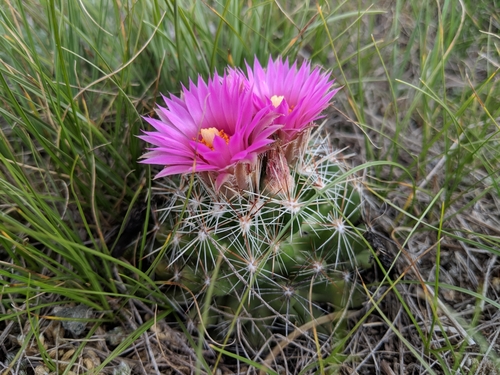
The Spinystar (Escobaria vivipara), also known as the beehive cactus, is a remarkably resilient small cactus that thrives in some of North America's harshest environments. Ranging from the hot deserts of northern Mexico and Texas up to the freezing plains of southern Canada, this cactus is built for survival. Despite its small size, it stands out for its beautiful, showy pink-to-purple flowers that bloom in late spring and summer. It often grows in dense, low-profile clumps, huddling against the rocky soil to shield itself from strong winds. This species is highly prized by naturalists and gardeners alike for its extreme cold hardiness. It is one of the few cactus species capable of surviving freezing winter temperatures down to -30 degrees Celsius. Its ability to shrivel and dehydrate during the winter prevents its cells from freezing and bursting, showcasing a spectacular evolutionary adaptation to temperate and sub-arctic climates.
生息地: Found in dry grasslands, rocky slopes, sagebrush steppes, and pinyon-juniper woodlands across North America.
This small, globe-shaped to cylindrical cactus grows individually or in tight clusters, reaching heights of 2 to 15 centimeters. It is densely covered in a complex array of white, gray, or reddish-brown spines that radiate from small bumps on the stem, giving it a fuzzy, beehive-like appearance. In late spring, it produces vibrant, cup-shaped flowers at the top of its stems, featuring brilliant shades of magenta, pink, or purple with prominent yellow stamens. After flowering, it develops small, green, egg-shaped fruits that gradually turn brown as they mature.
カテゴリ
植物レア度
Common
危険度
1/5 · 非常に低い
スナップ
最初にスナップしよう!
Indigenous peoples historically used the sweet, ripe green fruits of this cactus as a food source, eating them fresh.
It is one of the most northern-ranging cacti in the world, surviving bitter Canadian winters where temperatures regularly drop below -30 degrees Celsius.
The species name 'vivipara' comes from Latin meaning 'live-bearing', referring to its habit of producing small clonal offsets or 'pups' around the base of the mother plant.
It actively dehydrates its tissues and concentrates sugars in its cells during winter to survive extreme freezing temperatures.
Its dense covering of overlapping spines protects against intense solar radiation, reduces wind-drying, and deters herbivores.
It opens its stomata only at night to capture carbon dioxide, minimizing water loss in arid environments.
As a photoautotroph, the Spinystar produces its own energy through photosynthesis, utilizing sunlight, carbon dioxide, and water absorbed via its shallow root system.
Agapostemon texanus
Provides nectar and pollen to native bees, which assist in cross-pollination.
Peromyscus maniculatus
Feeds on the seeds and fleshy pulp of the cactus fruits, aiding in seed dispersal.
このオブジェクトにはまだ特徴バッジが割り当てられていません。
まだ別名はありません。
テーマが追加されると、このオブジェクトのコレクションがここに表示されます。
危険度
1/5 · 非常に低い
まだ特別な安全上の注意はありません。
Spinystarを識別する最も簡単な方法は、Snappit自然識別アプリを使用することです。
2-15 cm
0.05-0.5 kg
10-30 年
As a photoautotroph, the Spinystar produces its own energy through photosynthesis, utilizing sunlight, carbon dioxide, and water absorbed via its shallow root system.
Found in dry grasslands, rocky slopes, sagebrush steppes, and pinyon-juniper woodlands across North America.
ズームインしてクラスターを分割し、このオブジェクトが撮影された場所を探索しましょう。
新しい観察が追加されると、ここに最近のスナップが表示されます。