

Splayed Deer Fly
chrysops caecutiens
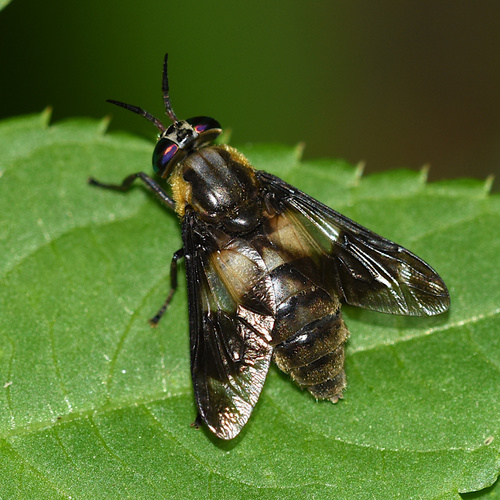
The Splayed Deer Fly (Chrysops caecutiens) is a distinctive and notorious member of the horse-fly family, Tabanidae. Widely distributed across Europe and northern Asia, this fly is famous for its striking gold-and-black patterned eyes and its aggressive, persistent biting behavior during the warm summer months. While male deer flies are gentle nectar-feeders, females require blood meals to develop their eggs, often targeting large mammals including deer, cattle, and humans. They are highly active on hot, humid days, flying silently before delivering a sharp, painful bite. Despite their reputation as pests, they play a critical role in local food webs as prey for birds and predatory insects, and males serve as useful pollinators.
生息地: Found in damp woodlands, marshes, peat bogs, and near shaded watercourses where their larvae can develop in wet soil or mud.
This medium-sized fly, measuring between 1 and 2 centimeters in length, is easily recognized by its spectacular, iridescent green eyes marked with dark purple or red-brown bands. The wings are highly characteristic, featuring a bold, dark brown or black band across the middle (the splayed pattern) while the tips remain completely clear. The abdomen is predominantly black with bright yellow-orange patches near the base, creating a wasp-like warning coloration. Females have a distinct dark, inverted V-shape on the second abdominal segment, which helps differentiate them from other closely related species.
カテゴリ
昆虫レア度
Common
危険度
1/5 · 非常に低い
スナップ
最初にスナップしよう!
Only female Splayed Deer Flies bite; males lack the specialized mouthparts required to pierce skin and instead feed entirely on flower nectar.
Their brilliantly colored, iridescent eyes lose all their vibrant green and gold hues shortly after the insect dies, turning a dull, dark brown.
Unlike common houseflies, deer flies are silent flyers, often landing on the back of a victim's head or neck completely unnoticed until they bite.
They use specialized compound eyes that detect polarized light, enabling them to easily locate water bodies for egg-laying and spot host movement through dense foliage.
When biting, the female injects a potent cocktail of anticoagulants and vasodilators to prevent host blood from clotting, ensuring a rapid feed.
The aquatic or semi-aquatic larvae possess water-repellent cuticles that allow them to breathe at the water's surface while hunting in mud.
Males feed exclusively on pollen and nectar, whereas females feed on nectar for energy and seek mammalian blood meals for egg development.
年齢による違い: Larvae are strictly predatory, feeding on small organic matter and soft-bodied aquatic invertebrates in wet soil, whereas adult males feed on nectar, and adult females consume both nectar and mammalian blood.
Capreolus capreolus
Host for adult females seeking blood meals to mature their eggs.
Anax imperator
Predator that hunts adult deer flies in flight over water and meadows.
Rana temporaria
Preys on both emerging adults and larvae in damp mud.
このオブジェクトにはまだ特徴バッジが割り当てられていません。
まだ別名はありません。
テーマが追加されると、このオブジェクトのコレクションがここに表示されます。
危険度
1/5 · 非常に低い
まだ特別な安全上の注意はありません。
Splayed Deer Flyを識別する最も簡単な方法は、Snappit自然識別アプリを使用することです。
1-2 cm
1-2 cm
0.00001-0.00003 kg
1-2 年
25 km/h
Males feed exclusively on pollen and nectar, whereas females feed on nectar for energy and seek mammalian blood meals for egg development.
Found in damp woodlands, marshes, peat bogs, and near shaded watercourses where their larvae can develop in wet soil or mud.
ズームインしてクラスターを分割し、このオブジェクトが撮影された場所を探索しましょう。
新しい観察が追加されると、ここに最近のスナップが表示されます。