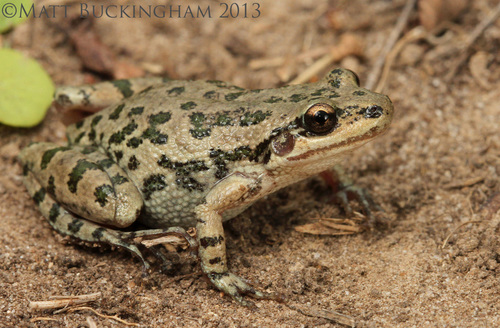


Spotted Chorus Frog
pseudacris clarkii
The Spotted Chorus Frog (Pseudacris clarkii) is a small, beautifully patterned amphibian native to the grasslands and prairies of the central United States and northern Mexico. Known for its energetic vocalizations, this tiny chorus frog comes alive during warm spring rains, congregating in temporary pools and roadside ditches to form loud, buzzing choruses. Its musical call, sounding similar to a fingernail running down a plastic comb, is a quintessential harbinger of spring in its native range. Despite its loud presence during breeding seasons, this frog is secretive and difficult to spot outside of these periods, spending its time hiding under leaf litter or loose soil.
生息地: Found in open prairies, grasslands, and savanna regions, typically associated with temporary shallow water bodies, flooded fields, and roadside ditches.
This small frog typically ranges from 2 to 3.5 centimeters in length. It features a pale green, grey, or tan base color adorned with prominent, irregular dark green spots that are often outlined in a lighter yellow or white border. A distinguishing field mark is a dark, triangular spot located between its eyes, as well as a light-colored stripe running along its upper lip. Its belly is smooth and cream-colored, and its toes have tiny, poorly developed pads, reflecting its terrestrial lifestyle.
カテゴリ
両生類レア度
Common
危険度
1/5 · 非常に低い
スナップ
最初にスナップしよう!
Their call sounds remarkably like a thumbnail dragging across the teeth of a stiff plastic pocket comb.
They are highly opportunistic breeders, sometimes laying eggs in puddle-filled tire tracks that dry up quickly.
Unlike true treefrogs, Spotted Chorus Frogs have very small toe pads and are terrible climbers, choosing instead to live on the ground.
Utilizes a large vocal sac that expands like a balloon to produce incredibly loud, metallic clicking calls that carry across vast distances.
Burrows into moist soil or utilizes existing cracks during dry spells to prevent dehydration, entering a dormant state until rain returns.
Adapted to highly ephemeral waters, its larvae can undergo metamorphosis in as little as three to four weeks before their pools dry up.
Feeds heavily on small terrestrial invertebrates such as insects, spiders, and centipedes, while its aquatic tadpoles feed on algae.
年齢による違い: Tadpoles are herbivorous and detritivorous, feeding on algae and organic matter, whereas adults are strictly carnivorous insectivores.
Thamnophis proximus
Predator that hunts the frogs in and around breeding pools.
Aedes vexans
An abundant insect prey species eaten by the adult frogs.
Ardea alba
Wading bird that opportunistically feeds on adult frogs in shallow waters.
このオブジェクトにはまだ特徴バッジが割り当てられていません。
まだ別名はありません。
テーマが追加されると、このオブジェクトのコレクションがここに表示されます。
危険度
1/5 · 非常に低い
まだ特別な安全上の注意はありません。
Spotted Chorus Frogを識別する最も簡単な方法は、Snappit自然識別アプリを使用することです。
2+ cm
0.001+ kg
2+ 年
2 km/h
Feeds heavily on small terrestrial invertebrates such as insects, spiders, and centipedes, while its aquatic tadpoles feed on algae.
Found in open prairies, grasslands, and savanna regions, typically associated with temporary shallow water bodies, flooded fields, and roadside ditches.
Ambush
ズームインしてクラスターを分割し、このオブジェクトが撮影された場所を探索しましょう。
新しい観察が追加されると、ここに最近のスナップが表示されます。