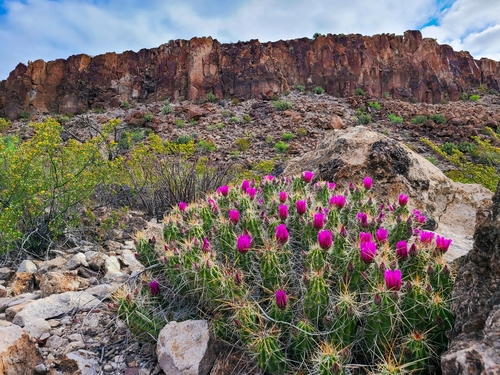


Strawberry Cactus
echinocereus enneacanthus
The Strawberry Cactus (Echinocereus enneacanthus) is a low-growing, highly clump-forming succulent native to the arid expanses of the Chihuahuan Desert. Famous for producing large, brilliant magenta flowers that can blanket entire hillsides in late spring, this plant is a striking visual highlight of desert landscapes. It gets its sweet common name from its edible, greenish-red, rounded fruits, which possess a delightful flavor reminiscent of fresh strawberries. This cactus forms massive, sprawling mounds that can survive the intense desert sun and prolonged dry spells, serving as an important source of moisture and food for native desert wildlife.
生息地: Thrives on arid gravelly slopes, alluvial fans, limestone hills, and shrubby desert flats.
This cactus features multiple cylindrical, pale green to yellowish-green stems that grow in dense clumps, with each stem possessing 7 to 10 prominent, slightly wavy ribs. The plant is heavily armed with clusters of sharp, yellowish-brown spines protruding from white circular areoles along the ribs. In late spring, vibrant funnel-shaped, magenta to deep purple flowers erupt near the stem tips, followed by small, egg-shaped fruits that ripen from green to a dull red and lose their outer spines when fully mature.
カテゴリ
植物レア度
Common
危険度
1/5 · 非常に低い
スナップ
最初にスナップしよう!
A single mature plant can form a massive clump with over 100 individual stems, stretching more than a meter in diameter.
Its scientific name 'enneacanthus' translates to 'nine-spined', which references the typical cluster of spines found on each of its areoles.
The sweet, edible fruits are traditionally gathered to make flavorful local jams and jellies.
Produces a sprawling network of over a hundred interconnected stems that helps prevent soil erosion and maximizes moisture capture in dry soils.
Opens its stomata only at night to absorb carbon dioxide, dramatically reducing water loss from evaporation during hot desert days.
Features a dense armor of pale spines that shade the stem surface from intense solar radiation and create a micro-barrier against wind.
As a photosynthetic plant, it generates its own energy from sunlight, water, carbon dioxide, and essential minerals from the soil.
Lasioglossum coactum
Bees and other native pollinators visit the large magenta flowers to gather nectar, facilitating cross-pollination.
Peromyscus eremicus
Desert rodents consume the sweet, ripe strawberry-flavored fruits and aid in the dispersal of seeds across the desert floor.
このオブジェクトにはまだ特徴バッジが割り当てられていません。
まだ別名はありません。
テーマが追加されると、このオブジェクトのコレクションがここに表示されます。
危険度
1/5 · 非常に低い
まだ特別な安全上の注意はありません。
Strawberry Cactusを識別する最も簡単な方法は、Snappit自然識別アプリを使用することです。
10+ cm
1+ kg
20+ 年
As a photosynthetic plant, it generates its own energy from sunlight, water, carbon dioxide, and essential minerals from the soil.
Thrives on arid gravelly slopes, alluvial fans, limestone hills, and shrubby desert flats.
ズームインしてクラスターを分割し、このオブジェクトが撮影された場所を探索しましょう。
新しい観察が追加されると、ここに最近のスナップが表示されます。





female.JPG&width=800)




.jpg&width=800)








