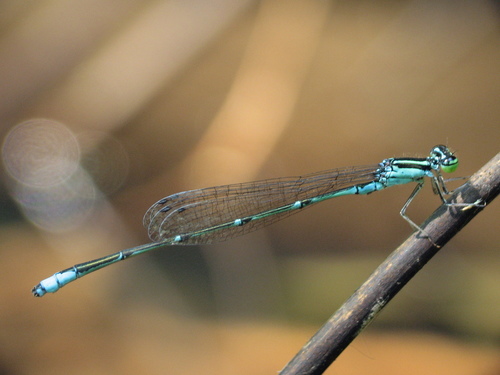
Stream Bluet
Enallagma exsulans
The Stream Bluet is a small, colorful dragonfly that loves to flutter around streams and ponds. With its bright blue body, it looks like a tiny jewel dancing in the air!
生息地: Wetlands
The Stream Bluet has a slender body, often bright blue in males with distinct black markings on its abdomen. Females are typically duller, ranging from brownish to greenish-tan, making them blend in more with vegetation. Its delicate appearance distinguishes it from stouter dragonflies.
カテゴリ
昆虫レア度
Common
危険度
1/5 · 非常に低い
スナップ
最初にスナップしよう!
A Stream Bluet spends most of its life underwater as a nymph, breathing through gills in its tail!
Damselflies like the Bluet can fly backwards, which helps them maneuver expertly through tight spaces!
Males 'guard' females while they lay eggs, ensuring no other males try to mate with them.
Unlike dragonflies, Stream Bluets hold their wings neatly folded together over their backs when resting.
Stream Bluet nymphs can ambush prey underwater because of their powerful extendable lower lip that helps them snatch small aquatic creatures.
Stream Bluet adults can dart and hover in the air because of their two pairs of independently moving wings, helping them catch flying insects.
Stream Bluets have large compound eyes that help them spot tiny prey and predators from many angles at once.
They are tiny hunters, catching and eating small insects both underwater as nymphs and in the air as adults!
年齢による違い: Nymphs hunt aquatic insects underwater, while adults catch flying insects in the air.
Culex pipiens
Adults prey on this common flying insect.
Micropterus salmoides
Nymphs are a food source for this freshwater fish.
Tachycineta bicolor
Adults are preyed upon by these aerial insectivores.
Lithobates catesbeianus
Both nymphs and adults can be eaten by this amphibian.
社会性動物は組織的な群れで生活し、採餌、防衛、子育てなど、生存に有利になるよう協力し合います。
空中性の生き物は、生涯の大部分を空中で過ごし、狩りや渡り、巣作りなど様々な活動を飛びながら行います。
カラフルとは、生物や物体が明るくはっきりとした多様な色合いを見せることを指します。
この特性は、主に昆虫やその他の小型無脊椎動物を食べる生物を示します。

この生息地特性は、湿地(年間を通して、または季節的に水に浸かっている沼や湿原などの土地)で見られる種を示します。

この特性は、狩り、逃走、または移動において、並外れた素早さを見せる生物を示します。

昼行性の動物は主に日中に活動し、通常は夜間に休息や睡眠をとります。

同種の標準や平均と比べて著しく小さい種に関する特徴。

淡水の生息地には、川、湖、池、湿地などの塩分を含まない水辺の環境が含まれ、多くの生物にとって不可欠な場所です。

花粉を運び、植物の受粉と繁殖を助ける生物のことを指します。
まだ別名はありません。
危険度
1/5 · 非常に低い
Watch dragonflies from a distance; they are friendly but like their space.
40-50 mm
26-32 mm
365-730 日
7 km/h
They are tiny hunters, catching and eating small insects both underwater as nymphs and in the air as adults!
Wetlands
Pursuit
6
ズームインしてクラスターを分割し、このオブジェクトが撮影された場所を探索しましょう。
新しい観察が追加されると、ここに最近のスナップが表示されます。