

Sullivant'S Coolwort
sullivantia sullivantii
Sullivant's Coolwort (Sullivantia sullivantii) is a rare and delicate perennial herb, a true gem of the North American flora. This small plant is a specialized inhabitant of cool, moist, shaded rock crevices, particularly sandstone and limestone cliffs. It is highly valued by botanists and nature enthusiasts for its unique habitat requirements and its status as a relict species, providing a living link to ancient ecological conditions. Its presence often indicates a pristine and stable microclimate, making it an ecological indicator species.
生息地: Sullivant's Coolwort is typically found clinging to moist, shaded, often north-facing sandstone or limestone cliffs, rock shelters, and ledges, frequently in association with seeping water or spray from waterfalls.
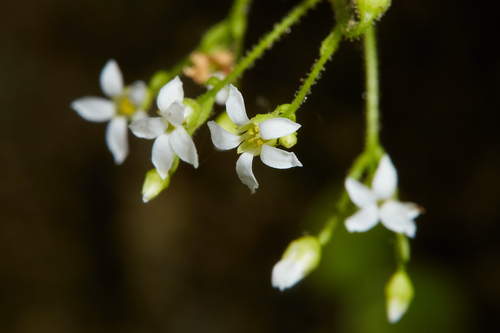
This charming plant features a basal rosette of bright green, kidney-shaped to nearly round leaves, which are often somewhat fleshy and have shallowly lobed or toothed margins. From this rosette, slender, reddish-tinged stems emerge, reaching heights of 10 to 30 centimeters. Each stem culminates in a loose, open cluster of small, star-like white flowers, typically five-petaled, often with a hint of pink or purple on the stamens, creating a delicate, airy appearance. The flowers are approximately 5-8 mm across.
カテゴリ
植物レア度
Common
危険度
1/5 · 非常に低い
スナップ
最初にスナップしよう!
It is considered a relict species, meaning it persisted in specific refugia during past climatic changes, especially glaciation.
Many of its populations are small and isolated, making them particularly vulnerable to environmental disturbances.
Sullivant's Coolwort is named after William Starling Sullivant (1803-1879), a prominent American botanist who discovered it in Ohio.
The common name 'Coolwort' directly refers to its preference for cool, moist environments, often found in the spray zones of waterfalls.
This species possesses a specialized ability to root and thrive exclusively within narrow rock crevices, utilizing the stable temperatures and moisture conditions found there.
Sullivant's Coolwort is highly dependent on consistent moisture from seeping water on cliff faces, having developed adaptations to efficiently absorb and retain water in these environments.
It is well-adapted to low light conditions, flourishing in the deep shade provided by rock overhangs and dense forest canopies typical of its cliff habitats.
As a photosynthetic plant, Sullivant's Coolwort produces its own food by converting light energy into chemical energy. It absorbs carbon dioxide from the air and water and nutrients from the soil through its root system.
Andrena spp.
Pollinator, contributing to the plant's reproduction.
Cornu aspersum
Herbivore, consuming plant foliage, though less common in cliff habitats.
Dryopteris marginalis
Co-occurs in similar moist, shaded microhabitats on cliffs.
このオブジェクトにはまだ特徴バッジが割り当てられていません。
まだ別名はありません。
テーマが追加されると、このオブジェクトのコレクションがここに表示されます。
危険度
1/5 · 非常に低い
まだ特別な安全上の注意はありません。
Sullivant'S Coolwortを識別する最も簡単な方法は、Snappit自然識別アプリを使用することです。
10-30 cm
3-10 年
As a photosynthetic plant, Sullivant's Coolwort produces its own food by converting light energy into chemical energy. It absorbs carbon dioxide from the air and water and nutrients from the soil through its root system.
Sullivant's Coolwort is typically found clinging to moist, shaded, often north-facing sandstone or limestone cliffs, rock shelters, and ledges, frequently in association with seeping water or spray from waterfalls.
Absorption
ズームインしてクラスターを分割し、このオブジェクトが撮影された場所を探索しましょう。
新しい観察が追加されると、ここに最近のスナップが表示されます。