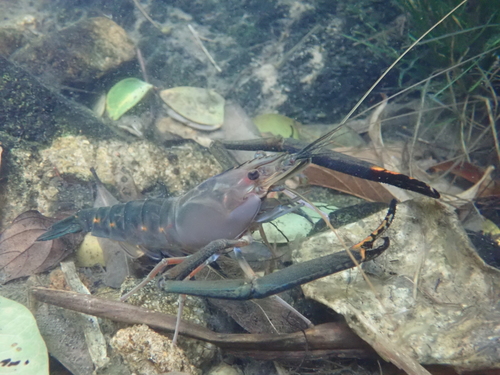


Tahitian Prawn
macrobrachium lar
The Tahitian Prawn, scientifically known as Macrobrachium lar, is an impressive freshwater crustacean native to the tropical streams and rivers of the Indo-Pacific region. This resilient decapod is highly regarded for its fascinating amphidromous life cycle, starting its life as larvae in brackish estuaries or the ocean before embarking on a challenging upstream migration into pristine mountain streams. Known for their distinctively long claws and active behavior, these prawns are vital ecological contributors, helping clean riverbeds by scavenging and keeping aquatic insect populations in check. They are highly adaptable creatures, capable of scaling wet rock faces to bypass waterfalls during their migration, which makes them a true marvel of river ecosystems.
生息地: Typically found in clear, fast-flowing freshwater streams and rivers with rocky substrates and overhanging vegetation throughout the Indo-Pacific islands.
This large prawn is characterized by its robust, marbled dark brown to deep bluish-black body, often with subtle lighter patterning along the abdominal segments. Mature males are particularly striking, possessing an exceptionally long and robust second pair of walking legs modified into powerful claws, which are often uneven in size and display a blue-grey coloration. The carapace is smooth and tough, while its long, sensitive antennae extend forward to detect prey and predators. Fully grown specimens typically measure between 10 to 18 centimeters in length, excluding their claws.
カテゴリ
Animalレア度
Common
危険度
1/5 · 非常に低い
スナップ
最初にスナップしよう!
Despite living in freshwater as adults, their larvae cannot survive without saltwater, requiring a journey to the ocean and back.
During upstream migration, juvenile Tahitian Prawns can climb vertical rock faces of waterfalls by gripping onto wet moss and algae.
Males have highly asymmetrical claws, with one often being much larger and stronger, used for defending territories and courting females.
They can crawl out of the water on wet rock surfaces to climb up steep waterfalls during upstream migration.
Larvae develop in saltwater before juveniles migrate back to freshwater rivers to mature.
They rapidly flex their muscular abdomen to swim backward at high speeds when threatened.
A generalist feeder that consumes a mixture of detritus, aquatic insects, algae, and small invertebrates found on stream beds.
年齢による違い: Larvae feed primarily on marine plankton, whereas adults transition to scavenging and opportunistic predation in freshwater habitats.
Anguilla marmorata
Preyed upon by large eels inhabiting the same freshwater streams.
Melanoides tuberculata
Feeds opportunistically on small freshwater snails along the riverbed.
Atyopsis spinipes
Competes for shelter and food sources in riverine rock crevices.
このオブジェクトにはまだ特徴バッジが割り当てられていません。
まだ別名はありません。
テーマが追加されると、このオブジェクトのコレクションがここに表示されます。
危険度
1/5 · 非常に低い
まだ特別な安全上の注意はありません。
Tahitian Prawnを識別する最も簡単な方法は、Snappit自然識別アプリを使用することです。
10-18 cm
0.05-0.15 kg
2-4 年
A generalist feeder that consumes a mixture of detritus, aquatic insects, algae, and small invertebrates found on stream beds.
Typically found in clear, fast-flowing freshwater streams and rivers with rocky substrates and overhanging vegetation throughout the Indo-Pacific islands.
Foraging
5000-20000
ズームインしてクラスターを分割し、このオブジェクトが撮影された場所を探索しましょう。
新しい観察が追加されると、ここに最近のスナップが表示されます。



