

Tall Ironweed
vernonia gigantea
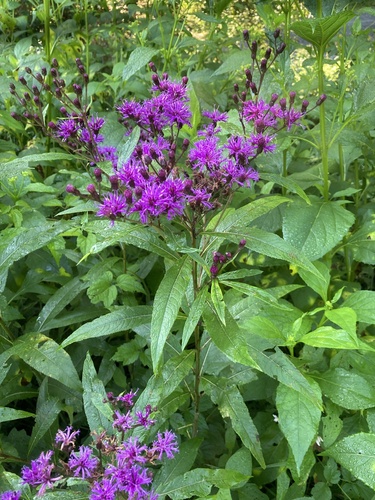
Tall Ironweed is a majestic, robust perennial wildflower native to the eastern and central regions of North America. Renowned for its towering height and intense, deep-purple blooms, this plant is a striking late-summer centerpiece in natural landscapes. Its tough, rigid stems allow it to stand upright despite heavy winds and rain, earning it the rugged name 'Ironweed'. Because of its late blooming season, it provides a crucial nectar source for native bees, butterflies, and other pollinators when many other floral resources have begun to fade. While pasture owners often view it as an aggressive weed due to its unpalatability to livestock, it is highly valued in native restoration projects and wildflower gardens for its ecological benefits and bold aesthetic appeal.
生息地: Found in moist soils, wet meadows, low-lying fields, pastures, and along roadsides or forest margins.
Tall Ironweed typically reaches heights of 100 to 300 centimeters, characterized by stout, coarse green to purplish stems that are mostly unbranched. Its leaves are lanceolate, finely serrated along the margins, and can grow up to 25 centimeters long, arranged alternately along the stem. The plant is crowned by loose, flat-topped clusters of numerous small, intense violet-magenta composite flower heads, which lack ray florets and consist entirely of tubular disc florets. After flowering, the seed heads mature into rusty-brown, fuzzy clusters that persist into the colder months.
カテゴリ
植物レア度
Common
危険度
1/5 · 非常に低い
スナップ
最初にスナップしよう!
Cattle avoid eating Tall Ironweed due to its bitter taste, allowing it to easily multiply and dominate overgrazed pasturelands.
The common name 'Ironweed' comes from the extremely tough, fibrous stems that remain standing long after the plant dies back in the winter.
The genus name Vernonia honors William Vernon, an English botanist who collected plant specimens in Maryland during the late 1600s.
Possesses remarkably tough, fibrous stems that resist breaking or bending, allowing the plant to stand tall through severe storms.
Synthesizes bitter sesquiterpene lactones that deter mammalian herbivores like deer and cattle from feeding on its foliage.
Produces highly concentrated nectar late in the season, acting as an essential energy source for migrating Monarchs and native bees.
As a photosynthetic plant, Tall Ironweed synthesizes its own sugars from sunlight, water, and carbon dioxide, while drawing minerals from the soil.
Danaus plexippus
Provides rich late-season nectar to migrating butterflies, aiding their long journey south.
Papaipema cerussata
The larvae of this moth bore into and feed on the internal stem tissue of the plant.
Melissodes dentiventris
A specialized native bee that frequently visits the flowers to collect pollen and nectar.
このオブジェクトにはまだ特徴バッジが割り当てられていません。
まだ別名はありません。
テーマが追加されると、このオブジェクトのコレクションがここに表示されます。
危険度
1/5 · 非常に低い
まだ特別な安全上の注意はありません。
Tall Ironweedを識別する最も簡単な方法は、Snappit自然識別アプリを使用することです。
100-300 cm
3-10 年
As a photosynthetic plant, Tall Ironweed synthesizes its own sugars from sunlight, water, and carbon dioxide, while drawing minerals from the soil.
Found in moist soils, wet meadows, low-lying fields, pastures, and along roadsides or forest margins.
ズームインしてクラスターを分割し、このオブジェクトが撮影された場所を探索しましょう。
新しい観察が追加されると、ここに最近のスナップが表示されます。





_(49869833552).jpg&width=800)










