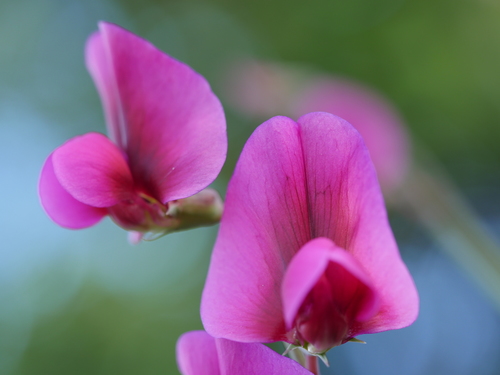


Tangier Pea
lathyrus tingitanus
The Tangier Pea (Lathyrus tingitanus) is a captivating climbing annual herb native to the Mediterranean region. Belonging to the legume family, Fabaceae, this vigorous plant scrambles over surrounding vegetation using its branched tendrils. It is widely admired for its eye-catching, pea-like flowers and serves dual purposes as an ornamental garden plant and a cover crop for green manure. However, outside its native range, it has established itself as an invasive species in regions like California and parts of Australia due to its resilient nature and rapid spread. Historically linked to the port city of Tangier, this species has successfully adapted to a variety of soils, including sandy coastal habitats. While it brings vibrant color to landscapes, its seeds contain toxins that prevent it from being a safe food source for humans or livestock in large quantities. This makes it a fascinating example of a beautiful but ecologically complex wildflower.
生息地: Found in open grasslands, coastal dunes, and disturbed areas like roadsides.
The Tangier Pea features striking, deep reddish-pink to crimson-purple flowers that typically measure 2 to 3 centimeters across and grow either singly or in pairs. The plant is a climbing vine characterized by distinctly 'winged' stems, which are flat, green, and leaf-like. Its leaves are comprised of a single pair of lance-shaped leaflets and terminate in a highly branched tendril used for climbing. Following flowering, it produces flat, oblong, hairless green seedpods that turn brown as they mature, housing several smooth, dark seeds.
カテゴリ
植物レア度
Common
危険度
1/5 · 非常に低い
スナップ
最初にスナップしよう!
Despite being in the pea family, the seeds of the Tangier Pea contain lathyrogens, which can cause a neurological disease called lathyrism if consumed in large quantities.
Its stems are uniquely 'winged', meaning they have flat, leaf-like appendages running along the sides of the stem, which help with photosynthesis.
The species name 'tingitanus' refers to Tangier, Morocco, one of the locations in its native North African range.
Utilizes highly sensitive, branched tendrils at the ends of its leaves to grasp nearby vegetation and climb toward sunlight.
Forms a symbiotic relationship with Rhizobium bacteria in its roots, allowing it to convert atmospheric nitrogen into nutrients.
Its seedpods twist open rapidly when dry, forcefully ejecting seeds several feet away to colonize new areas.
As a photosynthetic plant, the Tangier Pea produces its own food using sunlight, water, and carbon dioxide, while absorbing minerals from the soil.
Apis mellifera
Bees visit the showy flowers for nectar and pollen, facilitating cross-pollination.
Rhizobium leguminosarum
Provides nitrogen to the plant in exchange for carbohydrates.
Bos taurus
Graze on the foliage, although mature seeds can be toxic in high quantities.
このオブジェクトにはまだ特徴バッジが割り当てられていません。
まだ別名はありません。
テーマが追加されると、このオブジェクトのコレクションがここに表示されます。
危険度
1/5 · 非常に低い
まだ特別な安全上の注意はありません。
Tangier Peaを識別する最も簡単な方法は、Snappit自然識別アプリを使用することです。
80-300 cm
1 年
As a photosynthetic plant, the Tangier Pea produces its own food using sunlight, water, and carbon dioxide, while absorbing minerals from the soil.
Found in open grasslands, coastal dunes, and disturbed areas like roadsides.
4-10
10-21 日
ズームインしてクラスターを分割し、このオブジェクトが撮影された場所を探索しましょう。
新しい観察が追加されると、ここに最近のスナップが表示されます。




.jpg&width=800)








