

Thicket Bean
phaseolus polystachios
The Thicket Bean (Phaseolus polystachios) is an enchanting wild perennial vine native to the eastern and central United States. As a proud wild cousin of our common garden beans, this climbing legume weaves its way through forest edges, rocky slopes, and brushy thickets. It serves as a vital component of woodland ecosystems, offering food and shelter to various native insects, birds, and mammals. Unlike cultivated annual beans, this hardy native survives the cold winters underground, sending up fresh, twining shoots each spring to seek out the sun. While largely ignored by modern agriculture, the Thicket Bean is of great interest to botanists and geneticists. It represents a vital reservoir of genetic diversity, housing natural resistances to pests and harsh weather that could one day safeguard our global food supply.
生息地: Found in dry or moist upland forests, thickets, and woodland borders, often climbing over other vegetation.
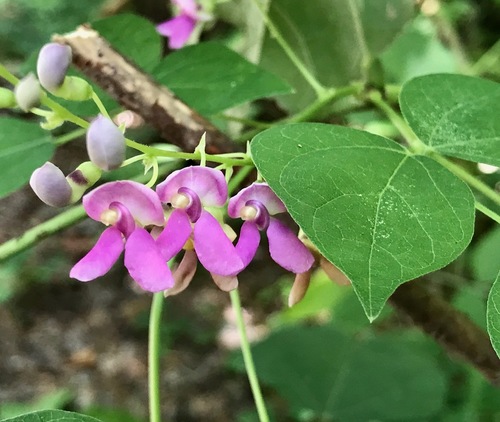
This climbing, twining herbaceous vine typically grows 100 to 400 centimeters long, wrapping its stems counter-clockwise around supporting plants. It is easily identified by its alternate, trifoliate leaves, each consisting of three broadly ovate to deltoid leaflets that span up to 10 cm in length. During mid-to-late summer, it produces loose, dangling clusters of pea-like flowers that range from a delicate pale pink to rich purple. These blooms give way to flattened, slightly curved green seed pods, about 4 to 8 cm long, which dry to a dark brown and twist open to release several mottled brown seeds.
カテゴリ
植物レア度
Common
危険度
1/5 · 非常に低い
スナップ
最初にスナップしよう!
It is a highly valuable crop wild relative (CWR), possessing genetic traits for disease resistance and climate adaptation that could benefit cultivated bean crops.
Its seed pods utilize a spring-loaded tension mechanism; as they dry, the pod valves twist and violently pop open, flinging seeds several feet away.
The Thicket Bean is the only species within the genus Phaseolus that is native to the eastern United States.
Forming a symbiotic relationship with Rhizobium bacteria in its root nodules, it converts atmospheric nitrogen into a usable nutrient form, enriching the surrounding soil.
As the seed pods dry out, they build up mechanical tension until they suddenly split and spiral outward, forcefully launching seeds away from the parent plant.
Lacking specialized tendrils, its stems sense contact with physical structures and twine tightly around them to climb rapidly toward sunlight.
As a photosynthetic plant, the thicket bean produces its own sugars from sunlight, water, and carbon dioxide, while sourcing nitrogen via symbiotic soil bacteria.
Epargyreus clarus
The caterpillars of the Silver-spotted Skipper butterfly use the foliage as a protective host plant and food source.
Bombus impatiens
Bumblebees visit the flowers for nectar, acting as the primary pollinators of the plant.
Odocoileus virginianus
White-tailed Deer browse on the nutrient-rich herbaceous leaves and young stems of the vine.
このオブジェクトにはまだ特徴バッジが割り当てられていません。
まだ別名はありません。
テーマが追加されると、このオブジェクトのコレクションがここに表示されます。
危険度
1/5 · 非常に低い
まだ特別な安全上の注意はありません。
Thicket Beanを識別する最も簡単な方法は、Snappit自然識別アプリを使用することです。
As a photosynthetic plant, the thicket bean produces its own sugars from sunlight, water, and carbon dioxide, while sourcing nitrogen via symbiotic soil bacteria.
Found in dry or moist upland forests, thickets, and woodland borders, often climbing over other vegetation.
ズームインしてクラスターを分割し、このオブジェクトが撮影された場所を探索しましょう。
新しい観察が追加されると、ここに最近のスナップが表示されます。