

Thistle Sage
salvia carduacea
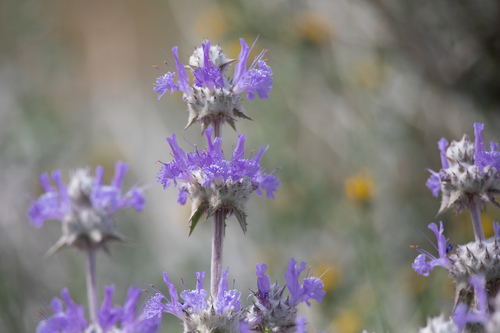
Thistle Sage (Salvia carduacea) is a striking annual wildflower native to the arid regions of California and Baja California. Despite its prickles and formidable thistle-like appearance, it belongs to the fragrant mint family (Lamiaceae). This resilient plant produces highly distinctive, bright lavender-to-purple flowers that feature beautifully fringed lower lips and contrasting bright red-orange anthers. Growing in sandy patches, washes, and dry fields, it is a hallmark of spring in the Mojave Desert and chaparral ecosystems. It has evolved to thrive in drought-prone environments, bursting into bloom during early spring and setting seeds before the extreme summer heat arrives. Indigenous peoples historically used its nutritious seeds for food and medicinal teas, highlighting its ecological and cultural value.
生息地: Found in dry, sandy or gravelly soils, desert washes, and open chaparral flats of California and Baja California.
Thistle Sage is easily recognized by its cobwebby, woolly stems and spiny, thistle-like basal leaves that are deeply lobed with white-margined teeth. The plant grows to a height of 15 to 100 cm, producing dense, ball-like whorls of pale purple or lavender flowers. Each flower exhibits a deeply fringed, fan-shaped lower lip and a pair of prominent, bright orange-red anthers that contrast sharply with the soft purple petals. The entire plant has a gray-green, woolly coating that helps conserve moisture, giving it a soft, dusty appearance from a distance.
カテゴリ
植物レア度
Common
危険度
1/5 · 非常に低い
スナップ
最初にスナップしよう!
Despite looking like a hostile thistle, it is actually a true sage and member of the fragrant mint family.
Its stunning, bright orange-red anthers contrast sharply with its purple petals to create a highly visible target for native bees.
The seeds of Thistle Sage were traditionally harvested by the Kawaiisu and other California Indigenous groups, who parched and ground them into a nutritious meal.
The plant is covered in dense, white, cobwebby hairs that reduce water loss by deflecting harsh desert sunlight and trapping a micro-layer of humid air.
Its thistle-like, spiny leaves deter herbivores from grazing on its foliage in resource-scarce desert environments.
The specialized lower lip of the lavender flower acts as a landing platform, flexing under the weight of bees to precisely dust them with pollen from its red anthers.
As a photosynthetic plant, Thistle Sage manufactures its own energy from sunlight, carbon dioxide, and water while absorbing essential mineral nutrients from the soil.
Bombus vosnesenskii
Serves as a primary pollinator, attracted to the bright lavender flowers and rich nectar.
Sylvilagus audubonii
May occasionally graze on the younger, less prickly leaves of the plant during early spring.
Apis mellifera
Frequently visits the fringed flowers to collect nectar, helping with pollination.
このオブジェクトにはまだ特徴バッジが割り当てられていません。
まだ別名はありません。
テーマが追加されると、このオブジェクトのコレクションがここに表示されます。
危険度
1/5 · 非常に低い
まだ特別な安全上の注意はありません。
Thistle Sageを識別する最も簡単な方法は、Snappit自然識別アプリを使用することです。
15-100 cm
0.05-0.3 kg
1 年
As a photosynthetic plant, Thistle Sage manufactures its own energy from sunlight, carbon dioxide, and water while absorbing essential mineral nutrients from the soil.
Found in dry, sandy or gravelly soils, desert washes, and open chaparral flats of California and Baja California.
14-28 日
ズームインしてクラスターを分割し、このオブジェクトが撮影された場所を探索しましょう。
新しい観察が追加されると、ここに最近のスナップが表示されます。