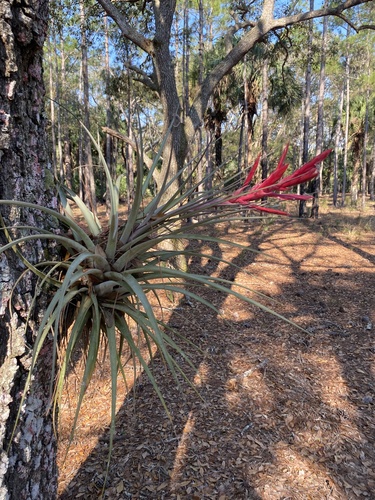


Tillandsia Fasciculata
tillandsia fasciculata
Tillandsia Fasciculata, commonly known as the Giant Airplant or Cardinal Airplant, is an iconic and visually striking epiphytic bromeliad native to the tropical and subtropical regions of the Americas. Unlike terrestrial plants, this remarkable species grows perched upon the limbs of host trees, suspended in the forest canopy. It does not parasitize its host but instead uses it solely for structural support, gathering moisture and essential nutrients directly from the humid air, rainfall, and falling organic debris.
生息地: Found in humid hammocks, cypress swamps, and pine flatwoods, typically growing high on the trunks and branches of host trees.
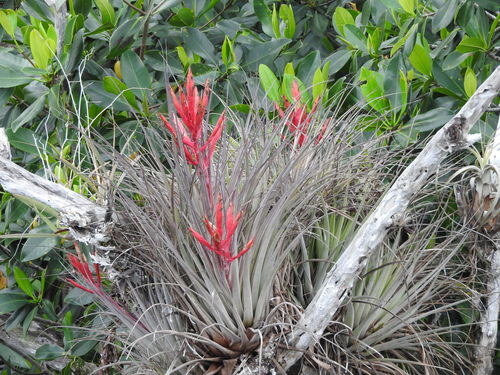
This large airplant forms a rosette of stiff, tapering, grayish-green leaves that can grow up to 60 centimeters in length. The foliage has a dusty appearance due to a dense covering of microscopic water-absorbing scales. When reproducing, it produces a spectacular, multi-branched flowering spike with vibrant, overlapping bracts in shades of brilliant red, yellow, and green, from which small, tubular, violet-purple flowers emerge.
カテゴリ
植物レア度
Common
危険度
1/5 · 非常に低い
スナップ
最初にスナップしよう!
Despite having roots, it can survive and even thrive when suspended completely in mid-air on a piece of wire or string, as long as it receives misting.
It is nicknamed the Cardinal Airplant due to the fiery red and yellow colors of its magnificent flowering bracts.
Its seeds are equipped with silky, parachute-like hairs that allow them to ride wind currents for miles before adhering to a new tree host.
Utilizes microscopic, umbrella-like leaf scales called trichomes to capture moisture, dew, and dissolved nutrients directly from the air.
Has evolved highly reduced, wire-like roots designed purely to cement the plant securely onto rough tree bark, completely bypassing the need for soil.
Conserves vital moisture by keeping its stomata closed during the hot day and opening them at night to absorb carbon dioxide.
Generates energy through photosynthesis while absorbing water and dissolved minerals from the atmosphere, rain, and decaying organic dust.
Taxodium distichum
Grows harmlessly on the trunk and upper limbs of this host tree for elevated access to sunlight and air currents.
Archilochus colubris
Feeds on the nectar of the tubular purple flowers, acting as a key pollinator in the canopy.
Metamasius callizona
An invasive pest insect whose larvae burrow into the plant's core, destroying the meristem and causing widespread mortality.
このオブジェクトにはまだ特徴バッジが割り当てられていません。
テーマが追加されると、このオブジェクトのコレクションがここに表示されます。
危険度
1/5 · 非常に低い
まだ特別な安全上の注意はありません。
Tillandsia Fasciculataを識別する最も簡単な方法は、Snappit自然識別アプリを使用することです。
20-60 cm
0.1-0.8 kg
10-20 年
Generates energy through photosynthesis while absorbing water and dissolved minerals from the atmosphere, rain, and decaying organic dust.
Found in humid hammocks, cypress swamps, and pine flatwoods, typically growing high on the trunks and branches of host trees.
ズームインしてクラスターを分割し、このオブジェクトが撮影された場所を探索しましょう。
新しい観察が追加されると、ここに最近のスナップが表示されます。



_Echeveria_secunda.jpg&width=800)













