

Tolpis Webbii
tolpis webbii
Tolpis webbii is a charming perennial subshrub endemic to the high-altitude zones of the Canary Islands, particularly Tenerife and La Palma. Belonging to the Asteraceae family, this resilient plant is a classic feature of the subalpine scrub and the understory of Canary Island pine forests. It thrives in volcanic, nutrient-poor soils, painting the dramatic volcanic landscapes with bursts of bright yellow flowers. Its ability to withstand intense solar radiation and seasonal drought makes it a vital pioneer species in these harsh environments, supporting local insect communities.
生息地: Found in high-altitude volcanic scrublands and Canary Island pine forests, typically on rocky, dry slopes.
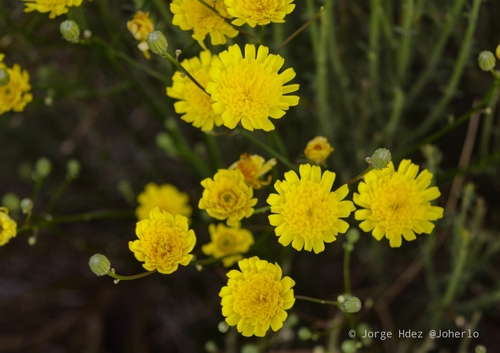
This plant grows as a woody-based herb or small subshrub reaching 20 to 60 centimeters in height. It features lance-shaped, grey-green leaves that are often clustered at the base or along the lower stems. Its most striking feature is the composite flower heads, which consist of numerous bright yellow ray florets surrounding a slightly darker central disc, mimicking a robust, multi-branched dandelion.
カテゴリ
植物レア度
Common
危険度
1/5 · 非常に低い
スナップ
最初にスナップしよう!
Despite its delicate, dandelion-like appearance, this plant has a woody base that allows it to survive as a perennial subshrub for years.
It is one of the iconic plant species that decorate the caldera of Teide, Spain's highest peak.
The species name 'webbii' honors Philip Barker Webb, an English botanist who co-authored the definitive 19th-century study on the Canary Islands' flora.
Successfully extracts nutrients and establishes roots in highly porous, young volcanic substrates.
Utilizes specialized leaf cuticles and deep root systems to survive prolonged dry spells in high-altitude environments.
Produces protective flavonoids in its foliage to mitigate damage from intense high-elevation solar radiation.
As a photoautotrophic plant, it produces energy through photosynthesis, converting sunlight, water, and carbon dioxide into sugars.
Pinus canariensis
Serves as an understory competitor for light and space with young saplings.
Bombus canariensis
Relies on native bees for pollination of its bright yellow flower heads.
Oryctolagus cuniculus
Introduced herbivores browse on its leaves and flower buds, impacting seedling survival.
このオブジェクトにはまだ特徴バッジが割り当てられていません。
まだ別名はありません。
テーマが追加されると、このオブジェクトのコレクションがここに表示されます。
危険度
1/5 · 非常に低い
まだ特別な安全上の注意はありません。
Tolpis Webbiiを識別する最も簡単な方法は、Snappit自然識別アプリを使用することです。
20-60 cm
2-7 年
As a photoautotrophic plant, it produces energy through photosynthesis, converting sunlight, water, and carbon dioxide into sugars.
Found in high-altitude volcanic scrublands and Canary Island pine forests, typically on rocky, dry slopes.
ズームインしてクラスターを分割し、このオブジェクトが撮影された場所を探索しましょう。
新しい観察が追加されると、ここに最近のスナップが表示されます。



.jpg&width=800)