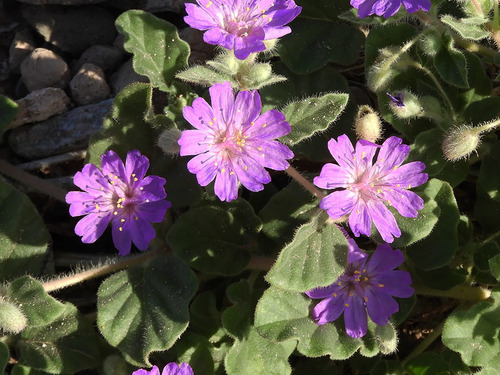


Trailing Windmills
allionia incarnata
Trailing Windmills (Allionia incarnata) is a resilient, low-growing perennial herb native to the arid desert regions of North and South America. Creeping along sandy and rocky soils, this plant is famous for its vibrant pink-to-purple blossoms that bring sudden bursts of color to harsh, dry landscapes. Its trailing stems form dense, sticky mats on the desert floor, helping to stabilize fragile soils while conserving precious moisture. Gardeners and nature enthusiasts admire Trailing Windmills for its extreme drought tolerance and its ability to thrive where few other plants can survive. It plays a vital role in desert ecosystems by providing nourishment for native pollinators and ground-dwelling herbivores.
生息地: Found in dry, sandy deserts, rocky slopes, and disturbed areas across arid regions.
This plant is easily identified by its prostrate, trailing stems that can spread up to a meter wide, covered in sticky glandular hairs that often accumulate a layer of dust or sand. The leaves are opposite, oval-shaped with wavy margins, and unequal in size within each pair. Its most distinctive feature is the pinkish-purple, windmill-shaped bloom which is actually a cluster of three distinct, funnel-shaped flowers grouped together to look like a single blossom, each with bright yellow stamens protruding from the center.
カテゴリ
植物レア度
Common
危険度
1/5 · 非常に低い
スナップ
最初にスナップしよう!
Although they appear to be single flowers, each pink bloom is actually a trio of three separate flowers blooming together in perfect symmetry.
The sticky hairs on the stems act like a natural sticky trap, collecting sand to insulate the plant from extreme desert heat.
This species belongs to the four o'clock family (Nyctaginaceae), meaning its flowers often open in the late afternoon and close by morning.
Groups three individual flowers together into a single, cohesive unit to create a larger, more attractive target for native pollinators.
Employs sticky, glandular hairs along its stems and leaves to collect dust and sand, creating a protective camouflage layer against herbivores.
Utilizes deep taproots and a prostrate growth form to minimize water loss and withstand extreme temperatures in arid desert soils.
As a photosynthetic plant, Trailing Windmills produces its own energy using sunlight, water, and carbon dioxide.
Hyles lineata
The flowers are visited and pollinated by hawkmoths, including the white-lined sphinx, as they forage for nectar.
Gopherus agassizii
The foliage and flowers are consumed as forage by the desert tortoise in its arid habitat.
このオブジェクトにはまだ特徴バッジが割り当てられていません。
まだ別名はありません。
テーマが追加されると、このオブジェクトのコレクションがここに表示されます。
危険度
1/5 · 非常に低い
まだ特別な安全上の注意はありません。
Trailing Windmillsを識別する最も簡単な方法は、Snappit自然識別アプリを使用することです。
10+ cm
1+ 年
As a photosynthetic plant, Trailing Windmills produces its own energy using sunlight, water, and carbon dioxide.
Found in dry, sandy deserts, rocky slopes, and disturbed areas across arid regions.
ズームインしてクラスターを分割し、このオブジェクトが撮影された場所を探索しましょう。
新しい観察が追加されると、ここに最近のスナップが表示されます。