

Treat'S Collared Ant
aphaenogaster treatae
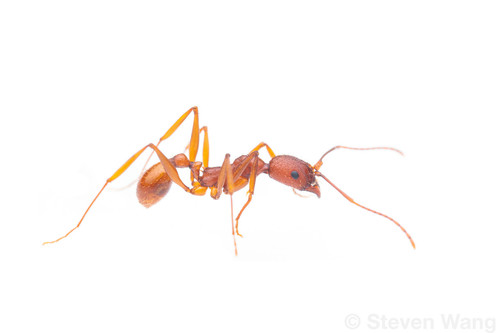
Treat's Collared Ant (Aphaenogaster treatae) is a fascinating, slender, reddish-brown ant native to the grasslands and open woodlands of eastern North America. Named in honor of the pioneering 19th-century American naturalist Mary Treat, this species plays an outsized role in the ecosystems it inhabits. They are keystone seed dispersers, participating in a vital mutualistic relationship called myrmecochory, where they carry away seeds of spring ephemerals to consume the fatty appendages (elaiosomes) before discarding the intact seed in their nutrient-rich nests. Beyond their gardening skills, these ants are voracious scavengers and proficient hunters of small arthropods. Their industrious nature makes them critical components of soil aeration and nutrient cycling. Observing a colony of Treat's Collared Ants provides a captivating window into the complex, hidden world of temperate insect ecology, highlighting their critical, often-overlooked contributions to forest and prairie health.
生息地: Found primarily in open woodlands, sandy prairies, and dry fields across eastern North America, where they excavate subterranean nests often marked by small, neat craters of sandy soil.
Treat's Collared Ant is a medium-sized ant, with workers typically measuring between 5 to 8 millimeters in length. They are characterized by a slender, leggy appearance and a uniform reddish-brown to dark brownish-red coloration across their entire body. The most distinctive identifying feature, and the source of their common name, is a specialized lobe or collar located at the base of the antennal scape (the first long segment of the antenna), which resembles a small, flattened shield. Their heads are somewhat elongated, and the thorax is notably sculpted with a pair of small, distinct spines protruding from the rear segment (the propodeum) just before the waist.
カテゴリ
昆虫レア度
Common
危険度
1/5 · 非常に低い
スナップ
最初にスナップしよう!
The distinctive 'collar' on their antennae helps scientists easily differentiate them from other closely related Aphaenogaster species in the field.
They act as nature's gardeners; by burying seeds in their underground waste chambers, they provide an ideal, nutrient-rich environment for new native plants to sprout.
This ant is named after Mary Treat, an American naturalist who corresponded extensively with Charles Darwin and made significant discoveries in entomology and botany.
Unlike many other ant genera, Aphaenogaster species generally cannot share liquid food via regurgitation, which is why they resort to using 'tools' like sand to carry liquids.
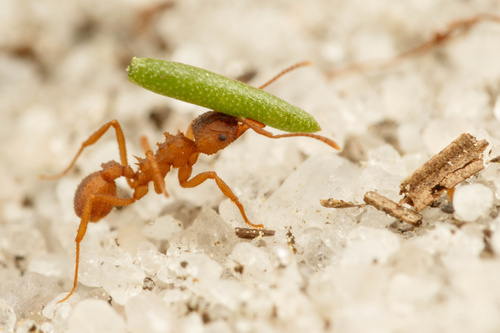
They actively collect seeds from woodland plants, consuming only the fatty, nutrient-rich elaiosome and leaving the seed intact to germinate safely in their protective, nutrient-dense nests.
Because they lack the ability to efficiently share liquids mouth-to-mouth, they use pieces of leaf litter, soil, or sand as sponges to soak up and transport liquid foods back to their colony.
They employ efficient pheromone trails to quickly recruit nestmates to large food sources like dead insects, allowing them to rapidly outcompete other scavenger species in their habitat.
They are opportunistic omnivores that heavily scavenge dead insects, hunt small invertebrates, and forage for specialized plant seeds and sugary honeydew.
年齢による違い: Larvae require higher protein diets derived from insect prey for growth, while adult workers rely more heavily on carbohydrates for energy.
Sanguinaria canadensis
Treat's Collared Ants disperse the seeds of this plant in exchange for eating its elaiosomes.
Colaptes auratus
These woodpeckers frequently forage on the ground, excavating ant nests to consume the workers and larvae.
Tetramorium immigrans
An invasive species that frequently competes with native ants for territory and food resources.
このオブジェクトにはまだ特徴バッジが割り当てられていません。
まだ別名はありません。
テーマが追加されると、このオブジェクトのコレクションがここに表示されます。
危険度
1/5 · 非常に低い
まだ特別な安全上の注意はありません。
Treat'S Collared Antを識別する最も簡単な方法は、Snappit自然識別アプリを使用することです。
0 cm
0-1 cm
0.000001-0.000005 kg
1-15 年
0 km/h
They are opportunistic omnivores that heavily scavenge dead insects, hunt small invertebrates, and forage for specialized plant seeds and sugary honeydew.
Found primarily in open woodlands, sandy prairies, and dry fields across eastern North America, where they excavate subterranean nests often marked by small, neat craters of sandy soil.
ズームインしてクラスターを分割し、このオブジェクトが撮影された場所を探索しましょう。
新しい観察が追加されると、ここに最近のスナップが表示されます。









%2C_Hartelholz%2C_M%C3%BAnich%2C_Alemania%2C_2020-06-28%2C_DD_362-382_FS.jpg&width=800)

