

Tree Lucerne
chamaecytisus proliferus
Tree Lucerne, also known as Tagasaste, is a versatile and fast-growing evergreen shrub or small tree native to the dry, volcanic slopes of the Canary Islands. Belonging to the legume family, this hardy plant is famous for its exceptional capacity to thrive in nutrient-poor, sandy soils and arid climates where other flora struggle. It is highly valued globally in agroforestry and permaculture as a living mulch, windbreak, and exceptionally nutritious stock fodder. Beyond its agricultural utility, Tree Lucerne is a vital ecological contributor. It bursts into a spectacular display of fragrant white flowers in late winter when few other plants are in bloom, providing an invaluable early nectar source for bees and birds. Its robust nature and ability to improve soil health make it an indispensable tool for land reclamation and erosion control.
生息地: Typically thrives in dry, volcanic, sandy, or gravelly soils in temperate and Mediterranean-type climates, often colonizing disturbed hillsides, coastal cliffs, and agricultural borders.
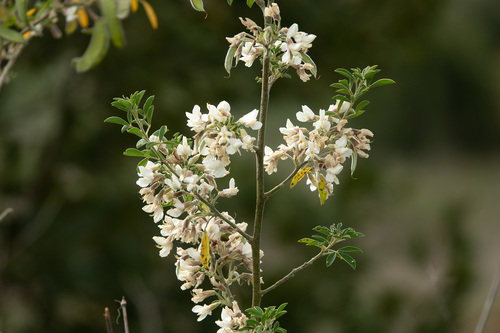
This small tree typically reaches heights of 3 to 7 meters, exhibiting a graceful, weeping growth habit with long, drooping branches. Its leaves are trifoliate, consisting of three dusty-green to grey-green leaflets that are smooth on top and velvety-fuzzy underneath. From late winter to early spring, the branches are heavily clustered with pea-like, creamy-white flowers that measure about 2 centimeters in length. These blossoms later develop into flat, velvety black seed pods containing small, hard seeds.
カテゴリ
植物レア度
Common
危険度
1/5 · 非常に低い
スナップ
最初にスナップしよう!
Because of its deep taproots, Tree Lucerne can stay vibrantly green and continue growing during severe summer droughts without irrigation.
Its flowers bloom in the dead of winter, providing a critical lifesaver for honey bees when almost no other nectar sources are available.
The leaves of Tree Lucerne can contain up to 30% crude protein, making its nutritional profile comparable to premium alfalfa.
Formulates a symbiotic relationship with beneficial soil bacteria to fix atmospheric nitrogen, significantly enriching the surrounding soil.
Features an extremely deep taproot system reaching up to 10 meters deep, allowing it to access subterranean water and survive intense droughts.
Possesses a highly resilient root system that allows the plant to quickly regenerate foliage after heavy grazing or pruning.
As a photoautotrophic legume, it produces its own energy via photosynthesis while utilizing specialized root nodules to convert atmospheric nitrogen into usable nutrients.
Apis mellifera
Feeds on the nectar and pollen of the winter-blooming flowers, acting as a primary pollinator.
Hemiphaga novaeseelandiae
Relies heavily on the evergreen foliage, shoots, and flowers as a vital winter food source when other food is scarce.
Ovis aries
Grazes on the high-protein leaves and twigs, utilizing it as an essential fodder crop in dryland farming.
このオブジェクトにはまだ特徴バッジが割り当てられていません。
まだ別名はありません。
テーマが追加されると、このオブジェクトのコレクションがここに表示されます。
危険度
1/5 · 非常に低い
まだ特別な安全上の注意はありません。
Tree Lucerneを識別する最も簡単な方法は、Snappit自然識別アプリを使用することです。
300-700 cm
20-40 年
As a photoautotrophic legume, it produces its own energy via photosynthesis while utilizing specialized root nodules to convert atmospheric nitrogen into usable nutrients.
Typically thrives in dry, volcanic, sandy, or gravelly soils in temperate and Mediterranean-type climates, often colonizing disturbed hillsides, coastal cliffs, and agricultural borders.
ズームインしてクラスターを分割し、このオブジェクトが撮影された場所を探索しましょう。
新しい観察が追加されると、ここに最近のスナップが表示されます。