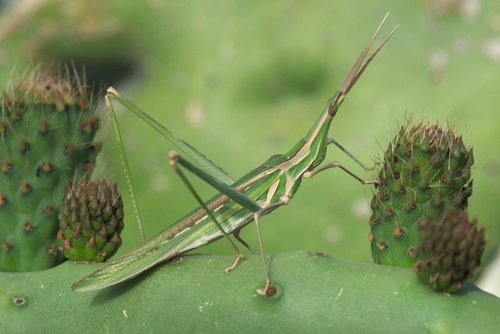


Truxalis Nasuta
truxalis nasuta
Truxalis nasuta, commonly known as the cone-headed grasshopper, is a fascinating orthopteran native to the Mediterranean basin, Africa, and parts of the Middle East. With its incredibly elongated, pointed head and slender, stick-like body, this insect is a master of mimicry. It blends seamlessly into arid grasslands and sandy shrublands, resembling a dry blade of grass. Its unique morphology and striking appearance make it a favorite among entomologists and nature enthusiasts alike. Despite its bizarre shape, it behaves much like other grasshoppers, relying on its powerful hind legs to catapult itself away from predators. During the warm months, its gentle buzzing can be heard across sun-baked plains, adding a subtle soundtrack to its dry habitat.
生息地: Typically found in hot, dry, and sandy environments such as coastal dunes, arid grasslands, and sparse scrublands.
This species features a remarkably elongated, cone-shaped head with antennae that are broad and flattened at the base, tapering to a point. The body is highly slender and reaches lengths of 3 to 8 centimeters, with females being significantly larger than males. Its coloration is typically a mix of straw-yellow, sandy-brown, or bright green, mimicking dry or living grasses. Light longitudinal stripes often run down its body, and its hind wings, visible during flight, may display subtle purplish or pinkish hues at the base.
カテゴリ
昆虫レア度
Common
危険度
1/5 · 非常に低い
スナップ
最初にスナップしよう!
Despite their awkward, elongated shape, they are surprisingly strong fliers and can travel significant distances when flushed.
Their cone-shaped head contains highly specialized musculature that supports their unique mouthparts and flattened antennae.
They are sometimes called 'nose-horned grasshoppers' due to the exaggerated, pointed profile of their head.
The insect's elongated body, pointed head, and coloration allow it to blend perfectly with dry grasses, making it nearly invisible to predators when stationary.
Using highly developed muscles in its elongated hind legs, it can leap immense distances relative to its body size to escape threats.
Males can produce unique buzzing sounds by rubbing their hind legs against their forewings, used primarily to attract mates during warm nights.
It feeds primarily on a variety of wild grasses and dry vegetation found in its arid habitat.
年齢による違い: Nymphs consume softer, young green grass shoots, while adults can digest tougher, dry grasses.
Brachypodium pinnatum
Feeds heavily on Mediterranean wild grasses, impacting local vegetation dynamics.
Falco naumanni
Preyed upon by insectivorous birds that hunt in dry scrublands.
Argiope lobata
Hunted by specialized arachnid predators in sandy dunes.
このオブジェクトにはまだ特徴バッジが割り当てられていません。
まだ別名はありません。
テーマが追加されると、このオブジェクトのコレクションがここに表示されます。
危険度
1/5 · 非常に低い
まだ特別な安全上の注意はありません。
Truxalis Nasutaを識別する最も簡単な方法は、Snappit自然識別アプリを使用することです。
3+ cm
6+ cm
0.001+ kg
1+ 年
12 km/h
It feeds primarily on a variety of wild grasses and dry vegetation found in its arid habitat.
Typically found in hot, dry, and sandy environments such as coastal dunes, arid grasslands, and sparse scrublands.
ズームインしてクラスターを分割し、このオブジェクトが撮影された場所を探索しましょう。
新しい観察が追加されると、ここに最近のスナップが表示されます。









.jpg&width=800)






