

Turk'S Head
hamatocactus hamatacanthus
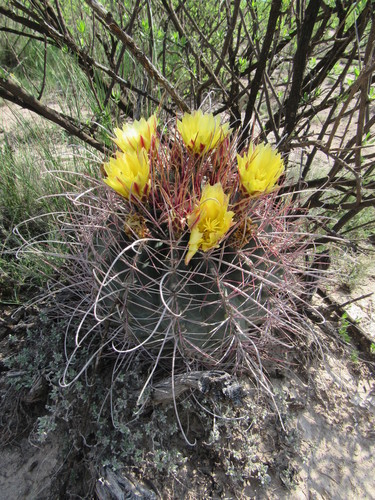
The Turk's Head cactus, scientifically known as Hamatocactus hamatacanthus, is a striking succulent native to the arid expanses of the Chihuahuan Desert. This resilient plant is famous for its heavily ribbed, globular to cylindrical body wrapped in a formidable armor of long, hooked spines. During the hot summer months, it transforms with the arrival of large, brilliant yellow flowers that feature deep red centers, providing a dramatic contrast to the desert landscape. These flowers eventually give way to edible, fleshy red fruits that are vital resources for local wildlife.
生息地: Found on rocky limestone hillsides, alluvial fans, and gravelly plains within desert scrub communities.
This cactus features a solitary, dark green, globose stem that can become cylindrical with age, reaching heights of up to 60 centimeters. It is defined by 13 to 17 pronounced, spiraling ribs. The most distinguishing feature is its clusters of spines, particularly the long, central spines that are conspicuously hooked at the tip and measure up to 12 centimeters in length. The spines start as a reddish-brown color before weathering to a chalky grey. Its summer flowers are large, funnel-shaped, bright yellow with red throats, and are followed by small, oval, red-colored fruits.
カテゴリ
植物レア度
Common
危険度
1/5 · 非常に低い
スナップ
最初にスナップしよう!
Its name 'Turk's Head' is shared with several other globular cactus species because their shape resembles a traditional Turkish fez.
The fleshy red fruits are entirely edible and possess a tart, pleasant flavor similar to wild gooseberries.
The sturdy, hooked spines of this cactus were occasionally used as actual fishing hooks by indigenous peoples of the region.
The sharply curved, hooked spines defend the cactus against thirsty herbivores and help capture condensing moisture from fog or dew.
Utilizes Crassulacean Acid Metabolism to open its stomata only at night, preventing critical water loss in scorched desert heat.
Triggers rapid flower bud development in response to summer monsoonal rain events to maximize pollination success.
Produces its own food through photosynthesis using sunlight, carbon dioxide, and water absorbed via its shallow root system.
Larrea tridentata
Young seedlings grow under the canopy of this shrub to survive the harsh desert sun.
Diadasia rinconis
This specialized bee visits the flowers for pollen and nectar, acting as a primary pollinator.
Peromyscus eremicus
Feeds on the sweet, ripe red fruits of the cactus and helps disperse its seeds.
このオブジェクトにはまだ特徴バッジが割り当てられていません。
まだ別名はありません。
テーマが追加されると、このオブジェクトのコレクションがここに表示されます。
危険度
1/5 · 非常に低い
まだ特別な安全上の注意はありません。
Turk'S Headを識別する最も簡単な方法は、Snappit自然識別アプリを使用することです。
15-60 cm
1-10 kg
20-50 年
Produces its own food through photosynthesis using sunlight, carbon dioxide, and water absorbed via its shallow root system.
Found on rocky limestone hillsides, alluvial fans, and gravelly plains within desert scrub communities.
ズームインしてクラスターを分割し、このオブジェクトが撮影された場所を探索しましょう。
新しい観察が追加されると、ここに最近のスナップが表示されます。


















