

Umbrella Plant
darmera peltata
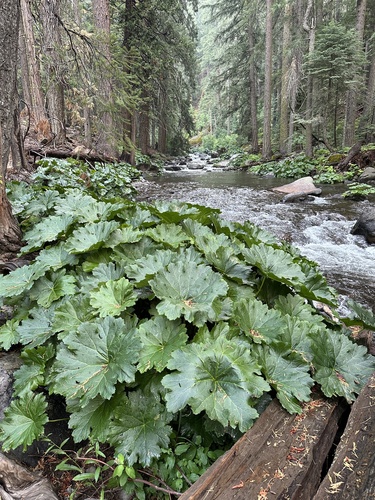
The Umbrella Plant (Darmera peltata) is a striking, clump-forming herbaceous perennial native to the mountain stream banks of western North America. It is renowned for its remarkable developmental sequence and gigantic, dramatic foliage. In early spring, before any foliage appears, the plant sends up tall, hairy pinkish-white flower stalks that contrast sharply with the bare riparian mud. As the blooms fade, the true spectacle begins as massive, round leaves unfurl, resembling inverted umbrellas. These leaves can reach up to two feet across, creating a dense canopy that dominates the forest floor near running water. It is a highly resilient species that has adapted perfectly to survive the high-energy flow of seasonal floods. Gardeners and nature enthusiasts alike prize this ancient-looking plant for its bold architectural form, its ecological role in stabilizing stream banks, and its stunning autumn display, where the lush green leaves transition into rich coppery-red and bronze hues.
生息地: Found along the margins of cool, fast-flowing mountain streams, wet woodlands, and seepages in coniferous forests.
This plant is easily identified by its massive, circular, peltate leaves which can measure up to sixty centimeters in diameter. The leaves are deep green with distinct veining radiating from a central depression where the long, fleshy petiole attaches, giving them a cup-like or umbrella appearance. In early spring, before the leaves emerge, the plant produces tall, leafless, bristly flowering stalks bearing dense, rounded clusters of small, five-petaled flowers that range in color from pale pink to white.
カテゴリ
植物レア度
Common
危険度
1/5 · 非常に低い
スナップ
最初にスナップしよう!
In autumn, the massive green leaves transition to brilliant shades of copper, red, and bronze before dying back for the winter.
Indigenous peoples of California once peeled and ate the young flower stalks raw or cooked as a spring vegetable.
The genus name Darmera honors Karl Darmer, a nineteenth-century German horticulturalist.
The plant produces flowers on tall, naked stalks in early spring before developing leaves. This ensures pollinators can easily see and access the blossoms without being obstructed by dense foliage.
Its umbrella-like leaves are structurally designed with the stem attached directly to the center, allowing them to capture rainwater and direct it efficiently down to the root system.
It possesses thick, fleshy, creeping rhizomes that anchor deeply into rocky stream banks, allowing the plant to withstand intense spring torrents without being washed away.
As an autotrophic plant, it produces its own energy through photosynthesis, utilizing sunlight, carbon dioxide, water, and minerals absorbed through its roots.
Bombus vosnesenskii
Provides nectar and pollen during early spring when few other plants are blooming.
Dicamptodon tenebrosus
Finds shelter and damp microhabitats beneath the massive shade-providing leaves.
このオブジェクトにはまだ特徴バッジが割り当てられていません。
まだ別名はありません。
テーマが追加されると、このオブジェクトのコレクションがここに表示されます。
危険度
1/5 · 非常に低い
まだ特別な安全上の注意はありません。
Umbrella Plantを識別する最も簡単な方法は、Snappit自然識別アプリを使用することです。
60-150 cm
10-50 年
As an autotrophic plant, it produces its own energy through photosynthesis, utilizing sunlight, carbon dioxide, water, and minerals absorbed through its roots.
Found along the margins of cool, fast-flowing mountain streams, wet woodlands, and seepages in coniferous forests.
Photosynthesis
ズームインしてクラスターを分割し、このオブジェクトが撮影された場所を探索しましょう。
新しい観察が追加されると、ここに最近のスナップが表示されます。













