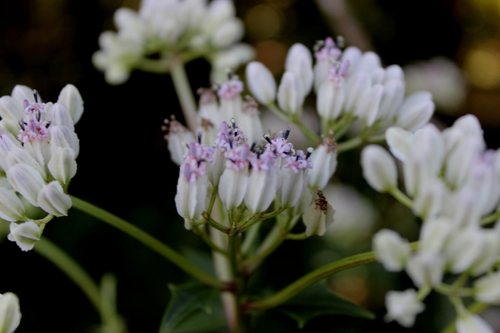


Variableleaf Indian Plantain
arnoglossum diversifolium
The Variableleaf Indian Plantain (Arnoglossum diversifolium) is a robust native perennial herb belonging to the Asteraceae family, commonly known as the sunflower family. It is particularly interesting for its highly variable leaf morphology, which can range from deeply lobed to almost entire on the same plant or within a population. This adaptability allows it to thrive in diverse microclimates within its habitat. Standing tall with impressive flower stalks in late summer, it provides crucial nectar resources for a variety of native pollinators, contributing significantly to local biodiversity. Its presence often indicates a healthy, undisturbed moist woodland or wetland ecosystem.
生息地: Found in moist to wet woodlands, forest edges, rich floodplains, stream banks, clearings, and sometimes roadsides, typically in partially shaded to full sun conditions.
This plant typically features large, distinctive basal leaves that are highly variable in shape, often ranging from ovate and unlobed to deeply palmately lobed, sometimes even on the same plant. These leaves are green, often with prominent veins. A stout, erect stem, usually greenish to purplish and glabrous, emerges from the basal rosette, reaching heights of 60 to 200 cm. The stem bears progressively smaller, narrower leaves. Atop the stem, a showy panicle of numerous small, disc-shaped flower heads appears, composed of many tiny white to greenish-white florets, blooming in mid to late summer.
カテゴリ
植物レア度
Common
危険度
1/5 · 非常に低い
スナップ
最初にスナップしよう!
It is a valuable host plant for the larvae of certain specialized moths and other insects, supporting native invertebrate biodiversity.
Its genus name, Arnoglossum, is derived from Greek words meaning 'lamb's tongue,' possibly referring to the shape of some of its basal leaves.
The species epithet 'diversifolium' directly translates from Latin to 'diverse leaves,' aptly describing one of its most defining characteristics.
This plant was formerly classified under the genus Cacalia, reflecting a history of taxonomic reevaluation within the Asteraceae family.
Exhibits remarkable variability in leaf shape, from deeply lobed to entire, an adaptation that allows it to optimize light capture and moisture retention across different microclimates and environmental conditions.
Utilizes a rhizomatous root system for vegetative propagation, enabling it to form colonies and persist effectively in its native habitats, contributing to its resilience and local spread.
Its tall inflorescences with numerous small flowers provide an abundant and accessible nectar source for a wide array of native bees, butterflies, and other beneficial insects, supporting ecosystem health.
As a plant, Arnoglossum diversifolium produces its own food through photosynthesis, converting sunlight, water, and carbon dioxide into sugars. It obtains essential mineral nutrients from the soil through its root system.
Papilio glaucus
Pollination, nectar source
Apis mellifera
Pollination, nectar source
Odocoileus virginianus
Herbivory, occasional browsing on foliage
Glomeromycota
Root association for nutrient uptake
このオブジェクトにはまだ特徴バッジが割り当てられていません。
まだ別名はありません。
テーマが追加されると、このオブジェクトのコレクションがここに表示されます。
危険度
1/5 · 非常に低い
まだ特別な安全上の注意はありません。
Variableleaf Indian Plantainを識別する最も簡単な方法は、Snappit自然識別アプリを使用することです。
60-200 cm
5-15 年
As a plant, Arnoglossum diversifolium produces its own food through photosynthesis, converting sunlight, water, and carbon dioxide into sugars. It obtains essential mineral nutrients from the soil through its root system.
Found in moist to wet woodlands, forest edges, rich floodplains, stream banks, clearings, and sometimes roadsides, typically in partially shaded to full sun conditions.
ズームインしてクラスターを分割し、このオブジェクトが撮影された場所を探索しましょう。
新しい観察が追加されると、ここに最近のスナップが表示されます。