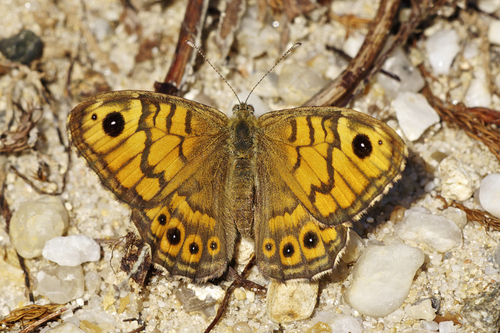


Wall Brown
lasiommata megera
The Wall Brown (Lasiommata megera) is a delightful and active member of the brush-footed butterfly family, Nymphalidae. Named for its signature habit of basking on warm stone walls, gravel paths, and rocks, this insect is a sun-loving species that thrives in open, stony habitats. Its striking orange and dark brown pattern, dotted with deceptive eyespots, makes it an eye-catching encounter for nature enthusiasts. In flight, the Wall Brown exhibits a rapid, skipping pattern, moving quickly from one sunny patch to another. Despite its historic abundance across temperate climates, this butterfly has suffered mysterious and dramatic population declines in inland regions, making coastal sightings particularly treasured. It remains a fascinating subject of study due to its territorial nature and superb thermoregulatory tactics.
生息地: Found in open, sunny environments with sparse vegetation and bare ground, such as disused quarries, railway embankments, rocky coastal cliffs, and gravel paths.
This medium-sized butterfly features upperwings painted in a rich, marbled orange pattern with dark brown veins and bands. The most distinctive identifier is a large, black, white-pupiled eyespot near the tip of each forewing, complemented by a row of smaller eyespots along the edges of the hindwings. When resting, the Wall Brown typically folds its wings to reveal a mottled, cryptic underside of grey, brown, and cream, which provides outstanding camouflage against stones and dry earth. Males can be distinguished by a prominent dark brand of scent-scales on their forewings, and their wingspan generally ranges from 3 to 5 centimeters.
カテゴリ
昆虫レア度
Common
危険度
1/5 · 非常に低い
スナップ
最初にスナップしよう!
Depending on the warmth of the region, the Wall Brown can produce up to three successive generations in a single year.
The butterfly gets its common name from its habitual behavior of basking on stone walls, rocks, and bare pathways to absorb solar heat.
To protect itself from predators while resting, the Wall Brown closes its wings to reveal a mottled grey-brown underside that perfectly mimics stone or dry soil.
It spreads its wings flat against stone walls or bare earth to rapidly absorb solar radiation, allowing it to fly in cooler conditions.
Large, concentric eyespots on the wingtips draw the attacks of birds and other predators away from the vulnerable body.
Males actively patrol small, warm territories, darting out aggressively to intercept and investigate any passing insects.
As caterpillars, they feed exclusively on various wild grasses, whereas the adult butterflies forage for nectar on a variety of wildflowers.
Dactylis glomerata
The primary larval host plant, providing nutrition for the developing caterpillar.
Rubus fruticosus
Provides a crucial nectar source for adult butterflies during the summer months.
Vespula vulgaris
Acts as a major predator of both larvae and adult butterflies in scrub habitats.
このオブジェクトにはまだ特徴バッジが割り当てられていません。
まだ別名はありません。
テーマが追加されると、このオブジェクトのコレクションがここに表示されます。
危険度
1/5 · 非常に低い
まだ特別な安全上の注意はありません。
Wall Brownを識別する最も簡単な方法は、Snappit自然識別アプリを使用することです。
222010212000021+ cm
3+ cm
0.0001+ kg
0+ 年
15 km/h
As caterpillars, they feed exclusively on various wild grasses, whereas the adult butterflies forage for nectar on a variety of wildflowers.
Found in open, sunny environments with sparse vegetation and bare ground, such as disused quarries, railway embankments, rocky coastal cliffs, and gravel paths.
ズームインしてクラスターを分割し、このオブジェクトが撮影された場所を探索しましょう。
新しい観察が追加されると、ここに最近のスナップが表示されます。











