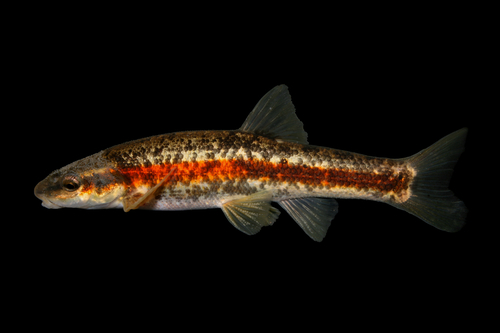


Western Blacknose Dace
rhinichthys obtusus
The Western Blacknose Dace is a charming and resilient little minnow native to the cool, fast-flowing headwater streams of eastern and central North America. Known for its energetic behavior and distinct coloration, this small fish plays a crucial role in freshwater ecosystems, serving as an indicator of clean water and a vital link in the aquatic food web. Despite its small size, it is a hardy species capable of navigating turbulent currents with ease. During the spring breeding season, males undergo a stunning transformation, flaring with vibrant orange and red hues along their flanks to attract mates.
生息地: Found in cool, clear, fast-flowing streams and small rivers with gravelly or rocky substrates.
This small minnow typically reaches 5 to 10 centimeters in length, featuring a slender, cylindrical body. It is characterized by a prominent dark, blackish lateral stripe that runs from the tip of its snout, through the eye, all the way to the base of the tail. Above this line, its back is an olive-green to dark brown color mottled with darker spots, while its belly is a contrasting silvery-white. During the breeding season, males develop bright red or orange coloration on their lower flanks and pectoral fins.
カテゴリ
魚類レア度
Common
危険度
1/5 · 非常に低い
スナップ
最初にスナップしよう!
Because they require clean, cool, oxygen-rich waters to thrive, their presence is often used by biologists as an indicator of good stream health.
During the spawning season, males will vigorously defend small nesting territories over gravel beds from other rival males.
Their dark lateral stripe acts as a form of disruptive camouflage, making them difficult for aerial predators like kingfishers to spot from above.
Their streamlined, fusiform body shape allows them to maintain position and swim efficiently against strong river currents.
Males develop brilliant, high-contrast orange-red lateral pigmentation to signal fitness and attract females during spring.
Utilizing specialized tactile and chemical receptors around their mouth, they easily detect hidden aquatic insect larvae under stream pebbles.
Primarily feeds on small benthic invertebrates, especially aquatic insect larvae, but also consumes algae and diatoms from submerged rocks.
Salvelinus fontinalis
Predator that feeds on dace in cool-water streams.
Semotilus atromaculatus
Competes with the dace for space and invertebrate prey in riffle habitats.
Chironomus plumosus
Common prey item for Western Blacknose Dace in larval stages.
このオブジェクトにはまだ特徴バッジが割り当てられていません。
まだ別名はありません。
テーマが追加されると、このオブジェクトのコレクションがここに表示されます。
危険度
1/5 · 非常に低い
まだ特別な安全上の注意はありません。
Western Blacknose Daceを識別する最も簡単な方法は、Snappit自然識別アプリを使用することです。
5+ cm
0.002+ kg
2+ 年
Primarily feeds on small benthic invertebrates, especially aquatic insect larvae, but also consumes algae and diatoms from submerged rocks.
Found in cool, clear, fast-flowing streams and small rivers with gravelly or rocky substrates.
Foraging
5002000+
ズームインしてクラスターを分割し、このオブジェクトが撮影された場所を探索しましょう。
新しい観察が追加されると、ここに最近のスナップが表示されます。








