

Western Coastal Wattle
acacia cyclops
The Western Coastal Wattle, also known as the red-eyed wattle, is a resilient evergreen shrub native to the coastal sand dunes and limestone cliffs of southern and western Australia. Thriving in wind-swept, salty environments, it plays a critical ecological role in dune stabilization, acting as an effective barrier against coastal erosion. Its dense, rounded dome of foliage offers vital cover and nesting sites for local wildlife in otherwise harsh and exposed habitats. This adaptable plant is famous for its unique seeds, which are encircled by a bright, eye-like red or orange stalk. This feature has unfortunately aided its spread beyond its native borders, making it an aggressive colonizer in other Mediterranean climates globally, such as South Africa's fynbos region.
生息地: Found on coastal sand dunes, limestone cliffs, and windy coastal scrublands, thriving in highly saline and sandy environments.
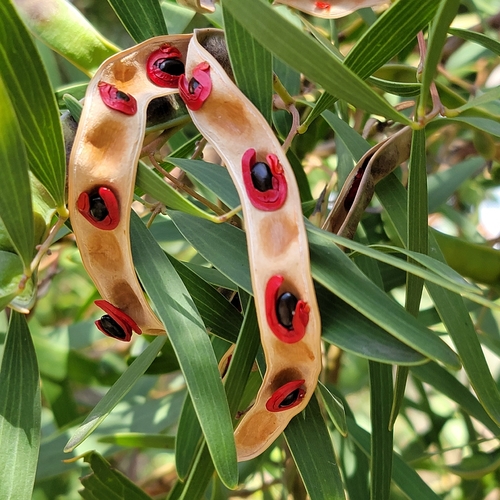
This species grows as a dense, dome-like shrub or small tree, reaching heights between 1.5 to 8 meters. It features narrow, slightly curved phyllodes (modified leaf stems) that are dark green, leathery, and measure up to 9 centimeters in length. During its blooming period, it produces small, bright yellow globular flower heads. The most distinctive feature is the seed pods; when ripe, they dry and twist open to reveal black seeds completely encircled by a prominent, ring-shaped, brilliant orange-to-red fleshy aril (funiculus), giving them the appearance of a tiny red eye.
カテゴリ
植物レア度
Common
危険度
1/5 · 非常に低い
スナップ
最初にスナップしよう!
Its hard-coated seeds are incredibly hardy and can lie dormant in coastal soils for years, germinating en masse following a wildfire or soil disturbance.
The species name 'cyclops' as well as the common name 'red-eyed wattle' directly reference the single black seed encircled by the bright red aril, which resembles a single red eye.
Unlike many Acacia species whose seeds are primarily carried by ants, this plant relies almost entirely on birds for seed dispersal because of its colorful, fatty arils.
Features a dense, low-growing canopy and tough, leathery phyllodes that resist heavy salt spray and high-velocity coastal winds.
Hosts symbiotic rhizobia bacteria in its root system, allowing it to convert atmospheric nitrogen into nutrients, enriching poor sandy soils.
Produces seeds wrapped in highly visible, lipid-rich red arils designed to attract birds, ensuring effective seed dispersal over long distances.
As a photosynthetic autotroph, it synthesizes its own food using sunlight, water, carbon dioxide, and essential soil nutrients.
Zosterops lateralis
Feeds on the seeds, consuming the nutrient-dense red arils and subsequently dispersing the seeds in its droppings.
Rhizobium leguminosarum
Forms a symbiotic relationship in the root nodules, converting nitrogen from the air into a form usable by the plant.
Trichosurus vulpecula
Feeds on the dense foliage and flower heads of the shrub.
このオブジェクトにはまだ特徴バッジが割り当てられていません。
まだ別名はありません。
テーマが追加されると、このオブジェクトのコレクションがここに表示されます。
危険度
1/5 · 非常に低い
まだ特別な安全上の注意はありません。
Western Coastal Wattleを識別する最も簡単な方法は、Snappit自然識別アプリを使用することです。
150-800 cm
10-30 年
As a photosynthetic autotroph, it synthesizes its own food using sunlight, water, carbon dioxide, and essential soil nutrients.
Found on coastal sand dunes, limestone cliffs, and windy coastal scrublands, thriving in highly saline and sandy environments.
ズームインしてクラスターを分割し、このオブジェクトが撮影された場所を探索しましょう。
新しい観察が追加されると、ここに最近のスナップが表示されます。



















