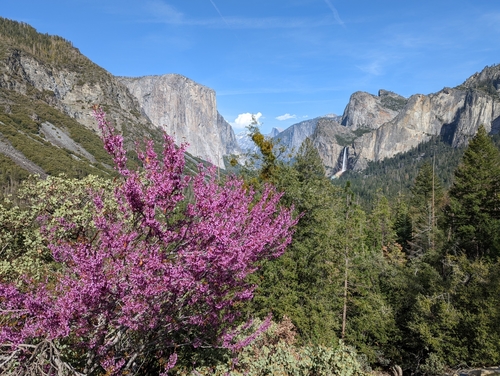


Western Redbud
cercis occidentalis
The Western Redbud (Cercis occidentalis) is a striking deciduous shrub or small tree native to the dry foothills, canyons, and chaparral of the American West, particularly in California, Arizona, Utah, and Nevada. Known for its spectacular early spring display, it erupts in clusters of bright pink to magenta flowers before its leaves emerge, providing a crucial early nectar source for native bees and butterflies. This resilient plant is well-adapted to drought-prone environments, featuring deep root systems and tough, leathery foliage. In addition to its beauty, the Western Redbud holds historical cultural significance. Native American tribes, particularly the Maidu, Miwok, and Kawaiisu, have long used its flexible, reddish branches in traditional basket weaving. Today, it is highly valued as an ornamental plant in water-wise landscaping (xeriscaping) due to its low water requirements, striking seasonal transitions, and ability to enrich the soil through nitrogen fixation.
生息地: Found in dry foothills, canyons, chaparral communities, and along desert streams in well-drained soils.
Western Redbud typically grows as a multi-trunked shrub or small tree reaching heights of 200 to 600 centimeters. In early spring, its bare, dark brown branches are densely covered in clusters of small, pea-like flowers ranging in color from deep pink to vibrant magenta. These are followed by distinctive heart-shaped, rounded leaves with a smooth texture that emerge apple-green and mature into a rich blue-green. In late summer and autumn, the foliage shifts to shades of yellow and red, accompanied by flat, dangling seed pods that measure 5 to 10 centimeters in length and turn a deep purple-brown.
カテゴリ
植物レア度
Common
危険度
1/5 · 非常に低い
スナップ
最初にスナップしよう!
Native Americans of the region used a fire-coaxing technique to burn redbud patches, which stimulated the growth of long, straight, flexible shoots ideal for weaving fine baskets.
The flat, purple-brown seed pods often hang on the bare branches throughout the winter months, offering a critical food resource for local birds and small mammals.
The flowers of the Western Redbud are entirely edible and have a pleasant, slightly sour, tangy taste, making them a colorful addition to spring salads.
Possesses root nodules containing symbiotic bacteria that convert atmospheric nitrogen into a usable form, enriching the surrounding soil.
Develops a deep, robust root system and thick, leathery leaf cuticles to minimize water loss and survive long, dry Mediterranean summers.
Capable of rapidly resprouting from its root crown after wildfires, allowing it to quickly reclaim territory in fire-prone chaparral ecosystems.
As a photoautotrophic plant, the Western Redbud synthesizes its own organic compounds from carbon dioxide and water using energy from sunlight.
Megachile fidelis
Pollinated primarily by native bees seeking early spring nectar and pollen.
Callophrys dumetorum
The foliage provides a key food source for caterpillars of this native butterfly.
Odocoileus hemionus
Browses on the tender leaves, young twigs, and seed pods of the redbud.
このオブジェクトにはまだ特徴バッジが割り当てられていません。
まだ別名はありません。
テーマが追加されると、このオブジェクトのコレクションがここに表示されます。
危険度
1/5 · 非常に低い
まだ特別な安全上の注意はありません。
Western Redbudを識別する最も簡単な方法は、Snappit自然識別アプリを使用することです。
200-600 cm
50-150 年
As a photoautotrophic plant, the Western Redbud synthesizes its own organic compounds from carbon dioxide and water using energy from sunlight.
Found in dry foothills, canyons, chaparral communities, and along desert streams in well-drained soils.
ズームインしてクラスターを分割し、このオブジェクトが撮影された場所を探索しましょう。
新しい観察が追加されると、ここに最近のスナップが表示されます。




_(10171293746).jpg&width=800)




_low_res.jpg&width=800)




