

White-Flowered Broom
cytisus supranubius
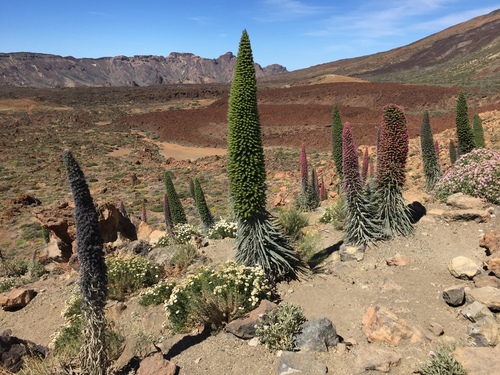
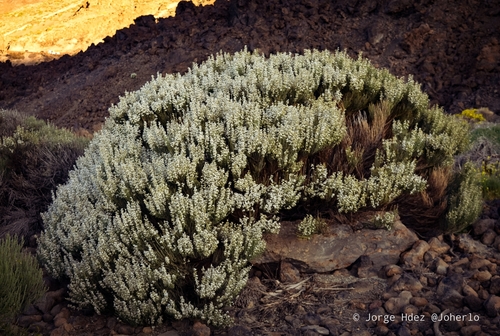
The White-Flowered Broom, scientifically known as Cytisus supranubius, is an iconic subalpine shrub endemic to the high-altitude volcanic landscapes of the Canary Islands, most notably Mount Teide on Tenerife and the highlands of La Palma. Locally called 'Retama del Teide', this resilient plant plays a vital ecological role, forming dense scrub communities that stabilize the loose volcanic soil and provide shelter for local fauna. It is celebrated for its spectacular spring display, where it transforms the rugged, barren caldera into a sea of fragrant white and pink blossoms.
生息地: Found in high-altitude volcanic scrublands and subalpine zones, typically at elevations between 1,800 and 3,000 meters above sea level.
This highly branched, rounded shrub typically reaches heights of 1 to 3 meters. It is characterized by its stiff, upright, grey-green stems that appear largely leafless for most of the year, a specialized adaptation to reduce water loss. The leaves are small, narrow, and trifoliate, falling off early in the season. In late spring, it bursts into dense, terminal clusters of small, pea-like white or pale pink flowers that blanket the plant and emit a highly sweet, honey-like fragrance.
カテゴリ
植物レア度
Common
危険度
1/5 · 非常に低い
スナップ
最初にスナップしよう!
Beekeepers move their hives to the Teide caldera in spring to produce 'Miel de Retama' (Broom Honey), a highly prized, light-colored local honey.
The species name 'supranubius' translates directly to 'above the clouds', describing its high-altitude habitat.
When in full bloom, the sweet scent of thousands of these shrubs can be smelled from miles away across the volcanic plateau.
Utilizes its green, broom-like stems to perform photosynthesis when leaves are shed to conserve moisture in dry, high-altitude air.
Houses symbiotic Rhizobium bacteria in its root nodules, allowing it to fix atmospheric nitrogen and enrich nutrient-poor volcanic soils.
Withstands intense solar radiation, extreme summer heat, drought, and freezing winter temperatures typical of alpine environments.
As a photosynthetic plant, it synthesizes its own food using sunlight, carbon dioxide, and water, supplemented by nitrogen fixed from the atmosphere through root symbiosis.
Bombus canariensis
Provides abundant nectar for pollination, which is critical for local honey production.
Oryctolagus cuniculus
The introduced European rabbit grazes heavily on young seedlings and shoots, threatening natural regeneration.
Gallotia galloti
The endemic lizard feeds on the fallen flowers and helps disperse the seeds.
このオブジェクトにはまだ特徴バッジが割り当てられていません。
まだ別名はありません。
テーマが追加されると、このオブジェクトのコレクションがここに表示されます。
危険度
1/5 · 非常に低い
まだ特別な安全上の注意はありません。
White-Flowered Broomを識別する最も簡単な方法は、Snappit自然識別アプリを使用することです。
100-300 cm
20-50 年
As a photosynthetic plant, it synthesizes its own food using sunlight, carbon dioxide, and water, supplemented by nitrogen fixed from the atmosphere through root symbiosis.
Found in high-altitude volcanic scrublands and subalpine zones, typically at elevations between 1,800 and 3,000 meters above sea level.
ズームインしてクラスターを分割し、このオブジェクトが撮影された場所を探索しましょう。
新しい観察が追加されると、ここに最近のスナップが表示されます。