

White Sage
salvia apiana
White Sage (Salvia apiana) is an evergreen perennial shrub native to the southwestern United States and northwestern Mexico. Revered for its intensely aromatic silver-white leaves, this plant plays a monumental role in the ecology of coastal sage scrub and chaparral ecosystems. For centuries, Indigenous peoples, particularly the Chumash and Kumeyaay, have held White Sage sacred, using it for purification ceremonies, traditional medicine, and food. Its striking, pale foliage reflects harsh desert sunlight, while its tall flower spikes act as magnets for local pollinators. Growing in dry, sandy soils, White Sage represents the resilient beauty of arid-adapted flora.
生息地: Found in coastal sage scrub, chaparral, and dry yellow-pine forests of Southern California and Baja California, typically below 1,200 meters elevation.
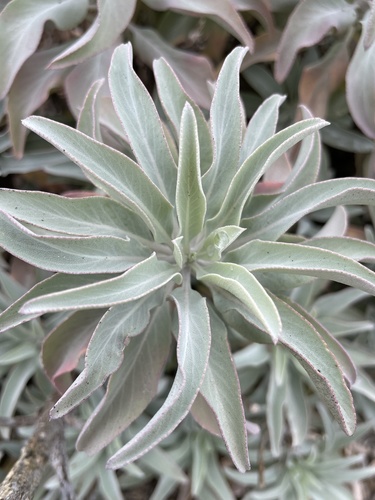
This shrub grows in dense, rounded mounds up to 1.5 meters tall and wide, with flowering stalks that can reach up to 2.5 meters. The leaves are lanceolate, finely toothed, and covered in a dense mat of tiny, white hairs, giving them a distinct silvery-white appearance. In spring and summer, it produces tall, arching flower spikes adorned with small, white-to-lavender flowers. The flowers feature long, protruding stamens that curl outward, designed to brush against visiting insects.
カテゴリ
植物レア度
Common
危険度
1/5 · 非常に低い
スナップ
最初にスナップしよう!
The silvery hairs on White Sage leaves act like a natural sunscreen, protecting the plant from the intense ultraviolet rays of the Southern California sun.
Traditional Indigenous groups used the seeds of White Sage as a food source, often grinding them into a nutritious meal called pinole.
White Sage belongs to the mint family (Lamiaceae), which explains its highly aromatic properties and square-shaped stems.
The leaves are covered in dense, white hairs that reflect solar radiation and prevent water loss.
Produces volatile terpene oils that protect the plant against insects and mammalian herbivores.
Possesses stamens that bend forward to deposit pollen on visiting bees when triggered by their weight.
Synthesizes its own nutrients using sunlight, water, and carbon dioxide through photosynthesis.
Bombus californicus
Pollinated primarily by large native bees that trigger the plant's unique floral mechanism.
Sylvilagus audubonii
Occasionally browses on young shoots, though older leaves are avoided due to strong oils.
Euphydryas editha quino
Feeds on the nectar of the white flowers during its flight season.
このオブジェクトにはまだ特徴バッジが割り当てられていません。
まだ別名はありません。
テーマが追加されると、このオブジェクトのコレクションがここに表示されます。
危険度
1/5 · 非常に低い
まだ特別な安全上の注意はありません。
White Sageを識別する最も簡単な方法は、Snappit自然識別アプリを使用することです。
100-250 cm
10-50 年
Synthesizes its own nutrients using sunlight, water, and carbon dioxide through photosynthesis.
Found in coastal sage scrub, chaparral, and dry yellow-pine forests of Southern California and Baja California, typically below 1,200 meters elevation.
ズームインしてクラスターを分割し、このオブジェクトが撮影された場所を探索しましょう。
新しい観察が追加されると、ここに最近のスナップが表示されます。