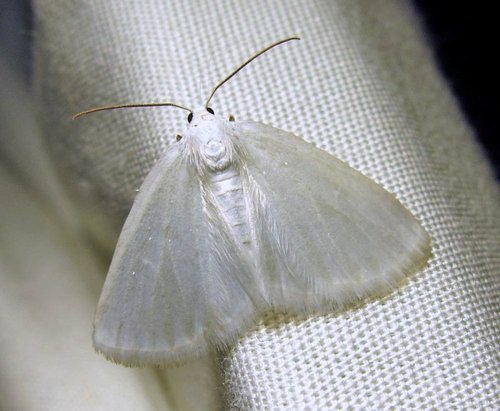


White Spring Moth
lomographa vestaliata
The White Spring Moth (Lomographa vestaliata) is a charming and common geometer moth species known for its strikingly pure white appearance. Often mistaken for a small piece of white detritus or a flower petal, this moth is a subtle yet integral part of various woodland and garden ecosystems across eastern North America. Its life cycle involves distinct larval and adult stages, with the caterpillars feeding on a variety of woody plants and the adults focused on reproduction, embodying a classic example of insect metamorphosis and ecological adaptation. Despite its unassuming nature, its presence indicates healthy plant diversity and provides a food source for nocturnal predators.
生息地: Found in deciduous and mixed forests, woodlands, suburban gardens, and fields where its host plants are present.
This small, delicate moth is almost entirely pure white, with a satiny or silky sheen on its wings. The wings are typically unmarked, though some individuals may exhibit extremely faint, almost imperceptible pale lines or a dusting of darker scales. The body is also white. Its wingspan is modest, giving it a petite and fragile appearance. When at rest, the wings are held flat, sometimes overlapping slightly, making it blend seamlessly with light-colored surfaces or blossoms. Its antennae are slender and thread-like.
カテゴリ
昆虫レア度
Common
危険度
1/5 · 非常に低い
スナップ
最初にスナップしよう!
Adult White Spring Moths are primarily focused on reproduction and typically have a very short adult lifespan, often only a week or two, during which feeding is secondary to mating and egg-laying.
Despite its name, 'Spring Moth', it can have a second brood emerging in the summer, making it visible for an extended period.
Its pure white color makes it stand out against dark backgrounds, but perfectly camouflages it against white flowers or light-colored bark, especially when resting.
The caterpillars of the White Spring Moth are often called 'loopers' or 'inchworms' due to their distinctive looping method of locomotion.
Its pure white wings provide exceptional camouflage against light-colored flowers, light-colored bark, or during its nocturnal flights under moonlight, making it difficult for avian and chiropteran predators to spot.
The White Spring Moth can produce two generations per year (bivoltine), typically emerging in spring and then again in early summer. This reproductive strategy allows it to maximize its population growth during favorable warm seasons.
Like many moth species, it is strongly attracted to artificial lights at night, a behavior that is beneficial for researchers monitoring insect populations but can also lead to increased predation risk.
As larvae, White Spring Moths are folivorous, feeding on the leaves of various woody plants. Adult moths, while capable of nectaring, often do not feed and instead focus their short lifespan on reproduction.
年齢による違い: Larvae consume plant foliage, while adults primarily do not feed or occasionally sip nectar.
Prunus serotina
Larvae feed on the leaves of this tree.
Myotis lucifugus
Adult moths serve as a food source for these nocturnal predators.
Turdus migratorius
Adult moths can be preyed upon by insectivorous birds, especially when resting during the day.
Hymenoptera species
Adult moths, if nectaring, may incidentally transfer pollen.
このオブジェクトにはまだ特徴バッジが割り当てられていません。
まだ別名はありません。
テーマが追加されると、このオブジェクトのコレクションがここに表示されます。
危険度
1/5 · 非常に低い
まだ特別な安全上の注意はありません。
White Spring Mothを識別する最も簡単な方法は、Snappit自然識別アプリを使用することです。
0-1 cm
1-2 cm
0.001-0.005 kg
0 年
5 km/h
As larvae, White Spring Moths are folivorous, feeding on the leaves of various woody plants. Adult moths, while capable of nectaring, often do not feed and instead focus their short lifespan on reproduction.
Found in deciduous and mixed forests, woodlands, suburban gardens, and fields where its host plants are present.
ズームインしてクラスターを分割し、このオブジェクトが撮影された場所を探索しましょう。
新しい観察が追加されると、ここに最近のスナップが表示されます。









.JPG&width=800)



