

Wild Hydrangea
hydrangea arborescens
The Wild Hydrangea (Hydrangea arborescens), also known as smooth hydrangea, is a beloved deciduous shrub native to the rich, moist forests and rocky banks of the eastern United States. Celebrated for its lush, sprawling form, this plant brings a touch of wild elegance to the forest understory with its large, dome-shaped clusters of creamy white flowers. Unlike its cultivated Asian cousins whose blossoms shift color based on soil pH, the wild hydrangea reliably displays soft, snowy white blooms throughout the summer. It plays an important role in its native ecosystem, providing structure to woodland margins, stabilizing slopes with its fibrous root system, and acting as a critical haven for local pollinators. It is a resilient and enchanting species that highlights the rich biodiversity of North America's deciduous woodlands.
生息地: Typically found in rich, moist soils along hardwood forest understories, rocky slopes, stream banks, and ravine bottoms.
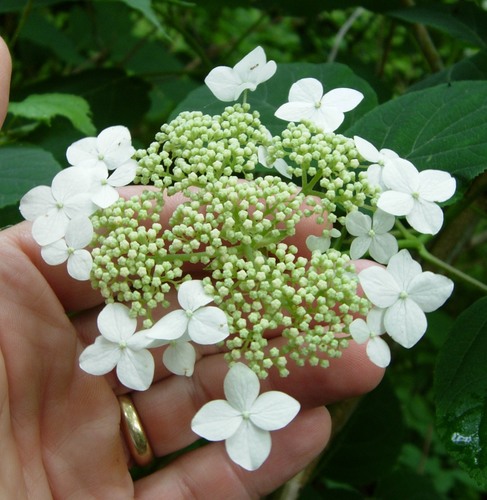
This deciduous shrub typically grows between 100 to 200 centimeters tall, forming a rounded, multi-stemmed mound. Its most striking feature is the large, flat-topped flower cluster (corymb), which can span up to 15 centimeters across and is composed of numerous tiny, fertile greenish-white flowers, sometimes ringed by larger, showy, sterile white flowers. The leaves are large, opposite, egg-shaped to heart-shaped, featuring sharply toothed margins and a dark green upper surface contrasted by a paler, smooth or slightly hairy underside.
カテゴリ
植物レア度
Common
危険度
1/5 · 非常に低い
スナップ
最初にスナップしよう!
Native Americans, such as the Cherokee, historically used the bark and roots of Wild Hydrangea for various medicinal purposes, including treating kidney stones.
The genus name Hydrangea comes from Greek words meaning 'water vessel', referring to the cup-like shape of its seed capsules.
Unlike European or Asian hydrangeas, the Wild Hydrangea's flower color is not affected by soil acidity and will always bloom white or pale green.
Develops a dense, fibrous network of roots that binds soil effectively, stabilizing steep, wet banks along woodland streams.
Utilizes large, sterile outer flowers to mimic massive blooms, attracting pollinators from afar to the smaller, fertile interior flowers.
Spreads via subterranean stolons, allowing it to regenerate quickly and form dense clonal colonies after canopy disturbances.
As a photosynthetic plant, the wild hydrangea produces its own energy using sunlight, carbon dioxide, and water.
Bombus bimaculatus
Forages on the pollen and nectar of the fertile interior flowers during the summer bloom.
Darapsa versicolor
The caterpillars of this moth feed exclusively or primarily on leaves of Hydrangea species.
このオブジェクトにはまだ特徴バッジが割り当てられていません。
まだ別名はありません。
テーマが追加されると、このオブジェクトのコレクションがここに表示されます。
危険度
1/5 · 非常に低い
まだ特別な安全上の注意はありません。
Wild Hydrangeaを識別する最も簡単な方法は、Snappit自然識別アプリを使用することです。
100-200 cm
10-30 年
As a photosynthetic plant, the wild hydrangea produces its own energy using sunlight, carbon dioxide, and water.
Typically found in rich, moist soils along hardwood forest understories, rocky slopes, stream banks, and ravine bottoms.
ズームインしてクラスターを分割し、このオブジェクトが撮影された場所を探索しましょう。
新しい観察が追加されると、ここに最近のスナップが表示されます。





















