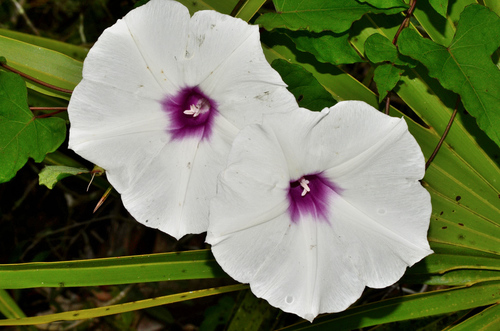


Wild Potato Vine
ipomoea pandurata
The Wild Potato Vine, scientifically known as Ipomoea pandurata, is a fascinating perennial herbaceous vine native to eastern North America. This robust plant is characterized by its vining habit and a remarkably large, starchy tuberous root that can grow to impressive sizes, giving it common names like 'Man of the Earth' or 'Manroot'. It is a member of the morning glory family (Convolvulaceae), displaying its characteristic trumpet-shaped flowers. Beyond its aesthetic appeal, the Wild Potato Vine plays a role in its ecosystem, providing nectar for various pollinators and serving as a food source for some herbivores, while its deep root system offers resilience in challenging conditions.
生息地: The Wild Potato Vine is typically found in open, sunny to partially shaded habitats such as old fields, roadsides, forest edges, clearings, and disturbed areas, preferring well-drained soils.
This vigorous vine features alternate, heart-shaped to fiddle-shaped leaves that are typically dark green. Its most striking visual identifier is its showy, trumpet-shaped flowers, which are predominantly white or creamy white with a deep reddish-purple or magenta throat. These attractive blooms usually measure 5-8 cm across and emerge from June through September. The vine itself can sprawl or climb extensively, reaching lengths of up to 6 meters. In the late season, it produces small, capsule-like fruits containing dark seeds.
カテゴリ
植物レア度
Common
危険度
1/5 · 非常に低い
スナップ
最初にスナップしよう!
Despite its common name, it is not closely related to the common potato (Solanum tuberosum) but is a member of the morning glory family, related to sweet potatoes (Ipomoea batatas).
Its vigorous vining growth can sometimes be considered aggressive in gardens, as it can quickly spread and entangle other plants if not managed.
Native American tribes historically used the roots of the Wild Potato Vine for various medicinal purposes, though its edibility as a staple food is debated due to potential bitterness or toxicity if not properly prepared.
The common name 'Man of the Earth' comes from its massive, often humanoid-shaped tuberous root, which can weigh over 20 kg (40 lbs).
Develops a massive, tuberous taproot that can weigh many kilograms and extend deep into the soil, allowing the plant to survive droughts, fires, and herbivory by storing vast amounts of carbohydrates and water.
Its vining growth habit allows it to climb over other vegetation, fences, and structures using its twining stems to reach optimal sunlight exposure for photosynthesis.
Produces large, showy, trumpet-shaped flowers with distinct color patterns (white petals, purple throat) that effectively attract a range of pollinators, including bees, butterflies, and hawk moths, ensuring reproductive success.
As a plant, Ipomoea pandurata produces its own food through photosynthesis, converting sunlight, carbon dioxide, and water into sugars. It absorbs essential minerals from the soil.
Manduca sexta
Hawk moths are important nocturnal pollinators for the Wild Potato Vine, drawn to its large, often fragrant flowers.
Bombus spp.
Many generalist bee species visit the flowers during the day to collect nectar and pollen, aiding in the vine's reproduction.
Odocoileus virginianus
White-tailed deer may browse on the leaves and young shoots of the Wild Potato Vine, especially in areas where it is abundant.
Bedellia somnulentella
Several insect larvae, including those of some sphinx moths, feed on the foliage of Ipomoea species.
このオブジェクトにはまだ特徴バッジが割り当てられていません。
まだ別名はありません。
テーマが追加されると、このオブジェクトのコレクションがここに表示されます。
危険度
1/5 · 非常に低い
まだ特別な安全上の注意はありません。
Wild Potato Vineを識別する最も簡単な方法は、Snappit自然識別アプリを使用することです。
300-600 cm
1-25 kg
10-30 年
As a plant, Ipomoea pandurata produces its own food through photosynthesis, converting sunlight, carbon dioxide, and water into sugars. It absorbs essential minerals from the soil.
The Wild Potato Vine is typically found in open, sunny to partially shaded habitats such as old fields, roadsides, forest edges, clearings, and disturbed areas, preferring well-drained soils.
Absorption
100-500
ズームインしてクラスターを分割し、このオブジェクトが撮影された場所を探索しましょう。
新しい観察が追加されると、ここに最近のスナップが表示されます。