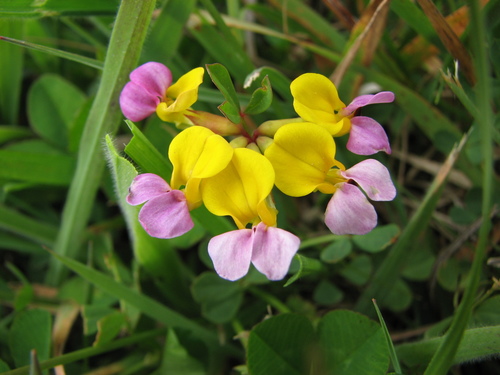


Witch'S-Teeth
hosackia gracilis
Witch's-Teeth (Hosackia gracilis), also known as the harlequin lotus, is a charming perennial herb native to the damp coastal meadows and wetlands of western North America. Belonging to the pea family (Fabaceae), this low-growing wildflower is celebrated for its striking, multi-colored blossoms that paint seasonal wetlands in hues of yellow and pink. It plays an important role in its local ecosystems, stabilizing wet soils and providing crucial nectar for native bumblebees. Historically found along the Pacific coastline from California up to British Columbia, this resilient plant thrives in moist, nutrient-poor soils where other plants struggle. Its presence is often an indicator of high-quality wetland habitats, and it serves as a critical host plant for several rare and localized insect species.
生息地: Found in wet meadows, coastal prairies, seeps, and margins of vernal pools at low elevations along the Pacific coast.
This low-growing perennial features sprawling or decumbent stems that reach between 10 to 40 centimeters in length. Its leaves are pinnately compound, typically consisting of 5 to 9 smooth, oval-shaped green leaflets. The defining feature is its beautiful umbel-like cluster of 3 to 9 pea-like flowers. Each flower showcases a vivid contrast: the upper banner petal is bright yellow, while the lateral wing and lower keel petals are a striking rose-purple to pale pinkish-white, creating a colorful, bi-toned appearance.
カテゴリ
植物レア度
Common
危険度
1/5 · 非常に低い
スナップ
最初にスナップしよう!
Because it fixes nitrogen, it acts as a natural fertilizer, helping pioneer plant communities re-establish in disturbed or nutrient-poor wetland soils.
It is a key indicator species for the health of coastal prairie ecosystems, which are among the most endangered habitats in North America.
The common name 'Witch's-Teeth' arises from the pointed, claw-like shape and sharp coloration of the flower buds before they fully open.
Forms a symbiotic relationship with Rhizobium bacteria in its roots to convert atmospheric nitrogen into usable nutrients, enriching poor soils.
Features specialized root adaptations that allow it to survive in saturated, oxygen-depleted soils during spring floods.
Employs a specialized keel petal mechanism that remains closed until a sufficiently heavy native bee lands on it, ensuring targeted pollen transfer.
As a photosynthetic plant, it utilizes chlorophyll to convert sunlight, carbon dioxide, and water into sugars, supplemented by nitrogen fixed from root nodules.
Plebejus anna lotis
Serves as a crucial larval food source for this highly endangered butterfly species.
Bombus vosnesenskii
Provides high-quality nectar and pollen, while the bee triggers the plant's unique pollination mechanism.
このオブジェクトにはまだ特徴バッジが割り当てられていません。
まだ別名はありません。
テーマが追加されると、このオブジェクトのコレクションがここに表示されます。
危険度
1/5 · 非常に低い
まだ特別な安全上の注意はありません。
Witch'S-Teethを識別する最も簡単な方法は、Snappit自然識別アプリを使用することです。
10-40 cm
2-5 年
As a photosynthetic plant, it utilizes chlorophyll to convert sunlight, carbon dioxide, and water into sugars, supplemented by nitrogen fixed from root nodules.
Found in wet meadows, coastal prairies, seeps, and margins of vernal pools at low elevations along the Pacific coast.
ズームインしてクラスターを分割し、このオブジェクトが撮影された場所を探索しましょう。
新しい観察が追加されると、ここに最近のスナップが表示されます。
















