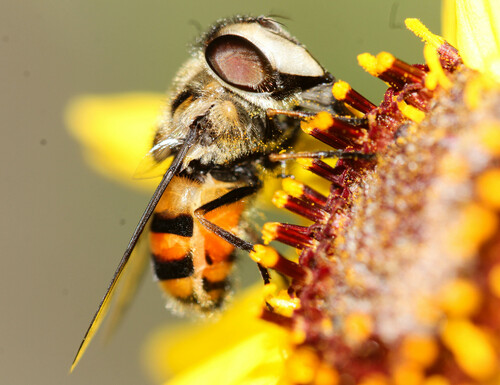


Yellow-Spotted Bromeliad Fly
copestylum avidum
The Yellow-Spotted Bromeliad Fly (Copestylum avidum) is a striking hoverfly renowned for its remarkable mimicry and unique life cycle. Belonging to the family Syrphidae, this insect masterfully mimics the appearance of stinging wasps or bees to deter predators, boasting distinctive yellow markings across its robust, dark-colored body. Despite its intimidating appearance, it is completely harmless to humans and plays a vital role as a pollinator in its native ecosystems. What makes Copestylum avidum particularly fascinating is its specialized larval development. Instead of laying eggs in open water or soil, females actively seek out water-filled bromeliad leaf axils or decaying plant matter. The larvae thrive in these miniature, nutrient-rich pools, breaking down decomposing plant tissue. This dual role—adults acting as vital pollinators and larvae acting as essential decomposers—makes the Yellow-Spotted Bromeliad Fly a crucial component of tropical and subtropical habitats.
生息地: Typically found in tropical and subtropical forests, humid cloud forests, and sometimes arid scrublands where host plants like bromeliads or large cacti are abundant.
This hoverfly features a stout, robust body approximately 10 to 15 millimeters in length, characterized by a dark brown to black base color adorned with vivid, symmetrical yellow spots or bands across its abdomen. Its head bears large, prominent compound eyes that meet at the top in males and are slightly separated in females. The wings are clear with subtle venation, spanning about 20 to 25 millimeters, and they rest flat over the abdomen when not in flight. Its overall appearance strongly mimics that of a vespid wasp, complete with a short, bee-like fuzz on the thorax, though it lacks a stinger entirely.
カテゴリ
昆虫レア度
Common
危険度
1/5 · 非常に低い
スナップ
最初にスナップしよう!
Adult Yellow-Spotted Bromeliad Flies have incredible flight control, able to hover perfectly in place, fly backward, and execute lightning-fast evasive maneuvers.
Despite strongly resembling a stinging wasp with its yellow and black markings, this fly is completely harmless and lacks a stinger.
The larvae of Copestylum flies are sometimes affectionately called 'rat-tailed maggots' because of the long breathing tube extending from their rears.
Their scientific genus name Copestylum translates loosely to 'oar-shaped style', referring to the distinct shape of their antennae.
It perfectly mimics the striking yellow and black warning patterns of stinging wasps, tricking predators like birds and spiders into avoiding them.
Capable of incredible aerial acrobatics, adults can hover completely motionless in mid-air and suddenly dart in any direction to evade capture.
The larvae possess a specialized telescopic breathing tube that acts like a snorkel, allowing them to breathe air while fully submerged in the oxygen-depleted pools of decaying bromeliads.
Adults primarily feed on flower nectar and pollen for energy and reproduction, while the aquatic larvae are detritivores that consume decaying plant matter and microbes.
年齢による違い: Undergoes a drastic shift from an aquatic detritivorous larva consuming decaying matter to a terrestrial nectarivorous adult consuming nectar and pollen.
Tyrannus melancholicus
Preys on adult hoverflies during mid-air catches or while resting.
Guzmania lingulata
Relies on the adult fly for pollination while providing nectar in return.
Billbergia nutans
The fly larvae accelerate the decomposition of dead leaves in its central pool, recycling nutrients.
このオブジェクトにはまだ特徴バッジが割り当てられていません。
まだ別名はありません。
テーマが追加されると、このオブジェクトのコレクションがここに表示されます。
危険度
1/5 · 非常に低い
まだ特別な安全上の注意はありません。
Yellow-Spotted Bromeliad Flyを識別する最も簡単な方法は、Snappit自然識別アプリを使用することです。
1 cm
2 cm
0.0001-0.0003 kg
0 年
15 km/h
Adults primarily feed on flower nectar and pollen for energy and reproduction, while the aquatic larvae are detritivores that consume decaying plant matter and microbes.
Typically found in tropical and subtropical forests, humid cloud forests, and sometimes arid scrublands where host plants like bromeliads or large cacti are abundant.
ズームインしてクラスターを分割し、このオブジェクトが撮影された場所を探索しましょう。
新しい観察が追加されると、ここに最近のスナップが表示されます。















