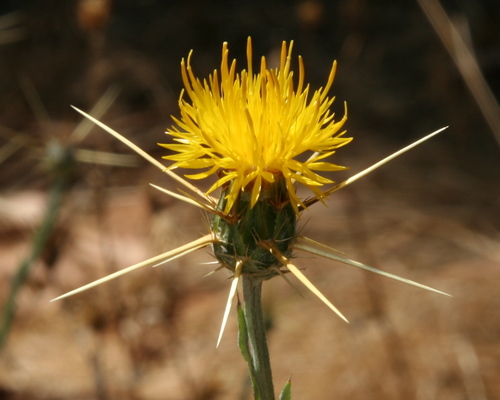


Yellow Star-Thistle
centaurea solstitialis
Yellow Star-Thistle (Centaurea solstitialis) is a highly invasive annual or biennial plant originating from Eurasia, now widespread across many parts of the world, particularly North America. Recognized for its striking yellow flowers and formidable spines, it poses significant ecological and economic threats, especially in rangelands and agricultural areas. This resilient species forms dense, impenetrable stands, outcompeting native vegetation, reducing biodiversity, and diminishing forage quality for livestock. Its remarkable adaptability and prolific seed production contribute to its success as a colonizer of disturbed habitats. Understanding and managing Yellow Star-Thistle is crucial for maintaining healthy ecosystems and productive landscapes.
生息地: Yellow Star-Thistle thrives in disturbed areas such as pastures, rangelands, roadsides, clearcuts, cultivated fields, and open grasslands, preferring well-drained soils and full sun.
Yellow Star-Thistle typically grows 30 to 150 cm tall, featuring a stiff, ridged stem that is often branched, giving the plant a bushy appearance. The leaves are grayish-green; basal leaves are deeply lobed, while stem leaves are narrow and unlobed. Its most distinctive feature is the bright yellow, thistle-like flower heads, which are borne singly at the tips of branches. Each flower head is surrounded by sharp, straw-colored spines, up to 2 cm long, emanating from the bracts (modified leaves) beneath the flowers, making it prickly to the touch.
カテゴリ
植物レア度
Common
危険度
1/5 · 非常に低い
スナップ
最初にスナップしよう!
Despite its formidable spines, the young rosettes of Yellow Star-Thistle are edible and were historically consumed by some cultures before flowering.
It is a highly competitive plant, capable of forming monocultures that can cover hundreds of acres, severely impacting rangeland productivity and native plant populations.
The plant contains a compound called repin, which can cause 'chewing disease' (nigropallidal encephalomalacia) in horses, a neurological condition affecting their ability to chew and swallow.
Yellow Star-Thistle seeds are dispersed by various means, including wind, water, animals, and human activities like contaminated hay or vehicle transport.
This plant develops a robust, deep taproot that can extend several meters into the soil. This allows it to access water and nutrients unavailable to many shallower-rooted native plants, conferring a significant competitive advantage, especially during dry periods.
Yellow Star-Thistle releases allelopathic chemicals into the soil. These compounds inhibit the germination and growth of neighboring plant species, effectively reducing competition and facilitating its dominance in invaded areas.
A single plant can produce tens of thousands of seeds, ensuring widespread dispersal and establishment. These seeds have varying dormancy periods, allowing them to remain viable in the soil seed bank for several years, leading to persistent infestations.
As a photosynthetic plant, Yellow Star-Thistle produces its own food by converting light energy into chemical energy. It absorbs water and essential mineral nutrients from the soil through its roots and carbon dioxide from the atmosphere through its leaves.
Eustenopus villosus
A biological control agent that lays eggs in the flower heads; larvae feed on developing seeds, reducing seed production.
Nassella pulchra
Displaced by dense stands of Yellow Star-Thistle, leading to reduced biodiversity and forage availability.
Ovis aries
Can graze on young Yellow Star-Thistle plants, but avoid mature, spiny plants, making it a less effective control method.
Tingis ampliata
Can be a host to various insect species, though it is primarily known for its negative interactions due to its invasiveness.
このオブジェクトにはまだ特徴バッジが割り当てられていません。
まだ別名はありません。
テーマが追加されると、このオブジェクトのコレクションがここに表示されます。
危険度
1/5 · 非常に低い
まだ特別な安全上の注意はありません。
Yellow Star-Thistleを識別する最も簡単な方法は、Snappit自然識別アプリを使用することです。
30-150 cm
0.1-1.5 kg
1-2 年
As a photosynthetic plant, Yellow Star-Thistle produces its own food by converting light energy into chemical energy. It absorbs water and essential mineral nutrients from the soil through its roots and carbon dioxide from the atmosphere through its leaves.
Yellow Star-Thistle thrives in disturbed areas such as pastures, rangelands, roadsides, clearcuts, cultivated fields, and open grasslands, preferring well-drained soils and full sun.
Photosynthesis And Nutrient Absorption
10000-100000
ズームインしてクラスターを分割し、このオブジェクトが撮影された場所を探索しましょう。
新しい観察が追加されると、ここに最近のスナップが表示されます。













_Symphoricarpos_albus_-_Fruits_and_foliage_-_Les_Martels%2C_Giroussens_Tarn.jpg&width=800)


