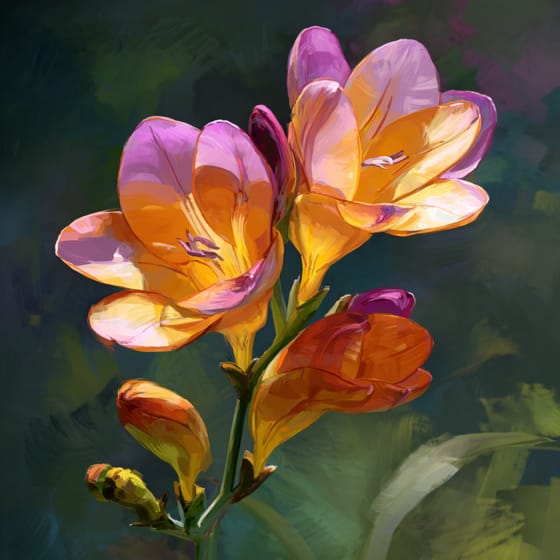





Freesia
Freesia
Freesias are sweet-smelling flowers that bloom in clusters. They are often used in bouquets for special occasions!
Habitat: Freesias thrive in sunny gardens and flower pots.
The Freesia has delicate, trumpet-shaped flowers that bloom in clusters along one side of a slender stem. They come in a rainbow of colors, including white, yellow, pink, red, purple, and often bi-colors, creating a vibrant display.
Category
PlantsRarity
Common
Danger
1/5 · Very low
Snaps
Be the first to snap!
Every Freesia flower stem can hold up to 10 trumpet-shaped blooms all lined up!
Freesia flowers are a global favorite, often used in bouquets to say 'thank you'!
Its incredible scent makes Freesia a prized ingredient in many fancy perfumes!
This beautiful flower was named after a German doctor and botanist, Dr. Friedrich Freese!
Freesia releases a strong, sweet perfume to attract bees and butterflies from far away, ensuring pollination.
Freesia stores energy in a special underground stem called a corm, helping it survive cold winters and bloom again.
Freesia flowers grow in a row on one side of the stem, creating an easy landing and navigation path for pollinators.
Apis mellifera
Collects nectar and pollen, aiding reproduction.
Vanessa cardui
Feeds on nectar, transferring pollen between flowers.
Helicoverpa armigera
Larvae sometimes feed on Freesia flowers and leaves.
Cluster flowers are inflorescences where individual flowers are arranged closely together on a common stem.
Spring blooming plants produce their flowers during the spring season, often signifying the end of winter and the start of new growth.
Fragrant flowers emit a pleasant aroma, often to attract pollinators or for defense.
This habitat trait indicates species that can coexist with humans in urban and suburban environments, utilizing man-made structures and green spaces.
Danger
1/5 · Very low
Explore with care and ask an adult if you’re unsure what to do.
30-60 cm
15-30 cm
3-5 cm
Late winter to spring
No
None
Perennial
Insect
Zoom in to split clusters and explore where this object has been snapped.
Recent snaps will appear here as new observations are added.