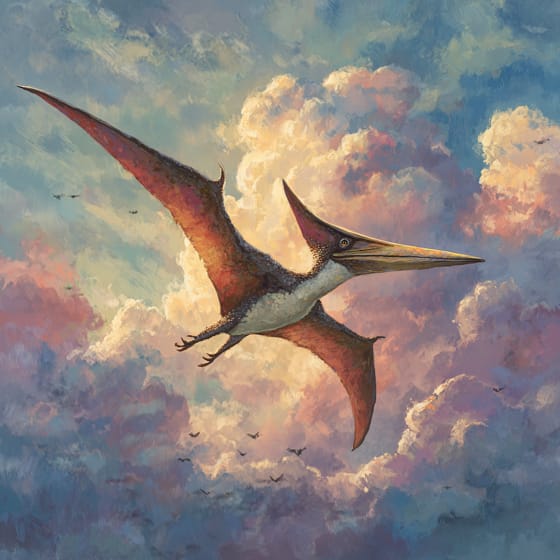





Pteranodon
Pteranodon longiceps
Pteranodon was a pterosaur— a flying reptile— that soared over coastlines and lakes using long wings.
Habitat: Mesozoic coastlines and lakes
The Pteranodon is a magnificent flying reptile with a massive, pointed head crest that can be larger in males. It has a long, toothless beak and a relatively small body with powerful, leathery wings. Its skin might have been shades of brown or grey, helping it blend with ancient skies and ocean rocks.
Category
AncientRarity
Common
Danger
1/5 · Very low
Snaps
Be the first to snap!
Despite its huge head crest, the Pteranodon had no teeth in its long, pointed beak!
Its enormous wingspan made it one of the largest flying animals to ever exist!
Pteranodon flew over ancient seas, like a giant seagull, searching for its next meal.
Scientists believe Pteranodon could travel hundreds of miles over the open ocean!
Pteranodon can soar for long distances over the ocean because of its huge, lightweight wings that help it catch air currents.
Pteranodon has a prominent head crest that might have helped it steer in the air or attract a mate during its dives for fish.
Pteranodon can spot fish from high in the sky because of its excellent eyesight, allowing precise dives into the water.
This ancient flyer was a skilled fisher, mostly eating fish it caught from the sea.
Enchodus ferox
Pteranodon often hunted these common fish in Cretaceous seas.
Cretoxyrhina mantelli
Large sharks might have preyed on Pteranodon if it landed on water.
Tylosaurus proriger
Giant marine reptiles could ambush Pteranodon near the water's surface.
Colorful describes organisms or objects displaying a wide range of bright and distinct colors.
Ancient refers to organisms, objects, or geological formations that have existed for an extremely long period.
An artifact is an object made or modified by human culture, typically of historical or archaeological interest.
A fossil is the preserved remains or traces of an ancient organism embedded in rock or other geological deposits.
No aliases listed yet.
Danger
1/5 · Very low
While extremely dangerous in their time, this creature is now extinct.
5-7 m
20-93 kg
This ancient flyer was a skilled fisher, mostly eating fish it caught from the sea.
Mesozoic coastlines and lakes
Pursuit
Late Cretaceous Period
86
Zoom in to split clusters and explore where this object has been snapped.
Recent snaps will appear here as new observations are added.