

Anemone Stinkhorn Fungus
aseroe rubra
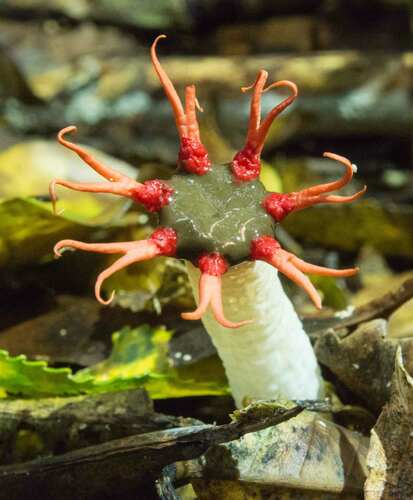
The Anemone Stinkhorn Fungus (Aseroe rubra) is one of the most bizarre and captivating fungi in the natural world. Resembling a sea creature misplaced on the forest floor, this species is famous for its bright red, star-shaped fruiting body that looks remarkably like a marine anemone. Native to Australia and New Zealand, it has captured the curiosity of naturalists and gardeners worldwide due to its striking appearance and its unique, albeit unpleasant, evolutionary strategy. Unlike typical mushrooms that rely on the wind to carry their spores, the Anemone Stinkhorn uses a cunning method of insect attraction. It produces a foul-smelling, brown slime at its center that mimics the odor of decaying meat. This pungent scent lures flies and beetles from afar, which walk through the slime and unwittingly disperse the sticky spores on their bodies, helping the fungus colonize new territories.
Lebensraum: Typically found growing on organic mulch, wood chips, garden beds, and moist forest floors within temperate and subtropical regions.
In its mature form, this fungus features a prominent star-like head with 6 to 10 bright red arms radiating from a central disk, which are deeply bifurcated at the tips to resemble tentacles. The central disk is covered in a dark, brownish-black, slimy spore mass called a gleba, which emits a strong carrion odor. Supporting this vibrant structure is a hollow, cylindrical stalk that transitions from white at the base to a pinkish-red near the top. Prior to expanding into this star shape, the fungus resembles a small, whitish or pale pink egg partially buried in the ground.
Kategorie
PilzeSeltenheit
Common
Gefahr
1/5 · Sehr gering
Snaps
Mach den ersten Snap!
Before unfurling into its dramatic anemone-like shape, the fungus resembles a small, white, gelatinous egg buried in the soil.
It was the very first Australian fungus to be formally described by scientists, collected in Tasmania in 1792.
Its scientific name Aseroe rubra translates roughly to 'disgusting red juice', referring to its slimy, foul-smelling spore mass.
Produces a complex blend of volatile organic compounds that mimic the stench of rotting flesh to attract fly pollinators.
Rapidly inflates its cellular structure with water, allowing the fruiting body to erupt from its egg-like stage within hours.
Generates a sticky, gelatinous matrix called gleba that firmly adheres to the legs and bodies of visiting insects.
As a saprotrophic organism, it survives by absorbing nutrients from decaying organic matter, helping break down wood and leaf litter.
Musca domestica
Attracted by the carrion scent, the fly feeds on the spore-rich gleba and disperses spores to new locations.
Calliphora stygia
Feeds on the slimy spore mass and carries spores away on its legs and abdomen.
Für dieses Objekt sind noch keine Merkmal-Badges vergeben.
Noch keine Alternativnamen vorhanden.
Sammlungen für dieses Objekt erscheinen hier, wenn weitere Themen hinzugefügt werden.
Gefahr
1/5 · Sehr gering
Noch keine besonderen Sicherheitshinweise.
Der einfachste Weg, Anemone Stinkhorn Fungus zu bestimmen, ist die Verwendung der Naturführer-App Snappit.
5-10 cm
0.01-0.05 kg
As a saprotrophic organism, it survives by absorbing nutrients from decaying organic matter, helping break down wood and leaf litter.
Typically found growing on organic mulch, wood chips, garden beds, and moist forest floors within temperate and subtropical regions.
Zoome hinein, um Cluster aufzulösen und zu sehen, wo dieses Objekt fotografiert wurde.
Neueste Snaps erscheinen hier, wenn neue Beobachtungen hinzukommen.