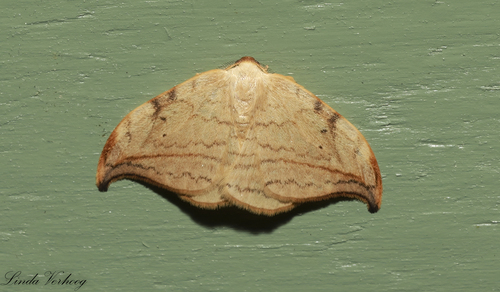


Arched Hooktip Moth
drepana arcuata
The Arched Hooktip Moth (Drepana arcuata) is a fascinating nocturnal moth native to North America, recognizable by its unique wing shape and intriguing larval behavior. Belonging to the family Drepanidae, this species is most commonly found in damp woodlands, deciduous forests, and shrubby areas near wetlands. While the adult moths are classic nocturnal flyers attracted to artificial lights, the caterpillars are famous for their semi-social interactions on host deciduous trees. A particularly remarkable feature of the Arched Hooktip caterpillar is its acoustic communication system; the larvae use specialized anatomical structures to scrape leaves, creating vibrations to defend their territories from rivals.
Lebensraum: Found in moist deciduous forests, wooded valleys, and shrubby areas near wetlands, closely tied to the presence of host birch and alder trees.
The Arched Hooktip Moth is easily identified by the strongly falcate (hooked) tips of its forewings, which span between 2.4 and 4.0 centimeters. The wings are decorated with a pale cream, yellow, or light brown base color, overlayed with wavy, dark transverse lines and a distinctive dark brown band running across the center of both the forewing and hindwing. A small, dark discal spot is usually visible near the center of the forewings. The caterpillars have a humpbacked appearance, transitioning from yellow-green to dark brown with mottled markings that perfectly mimic bird droppings or damaged leaves.
Kategorie
InsektenSeltenheit
Common
Gefahr
1/5 · Sehr gering
Snaps
Mach den ersten Snap!
Adult moths completely lack functional feeding organs, meaning they live only a few weeks on stored energy to mate and lay eggs.
Arched Hooktip caterpillars scrape their mouthparts and anal oars against dry leaves to produce acoustic vibrations that ward off territorial intruders.
This moth produces two separate generations each year across much of its range, with adults flying in late spring and again in late summer.
Caterpillars scrape and scratch specialized anal structures against leaves to produce vibrational signals that defend territory and deter rivals.
The hooked margins of the adult forewings perfectly resemble the dry, curled edges of dead leaves, providing excellent camouflage when resting.
Females release potent, species-specific chemical pheromones at night, which males detect from great distances using their highly sensitive plumose antennae.
The caterpillars feed aggressively on the leaves of birch and alder trees, whereas the adult moths have reduced mouthparts and do not feed.
Altersunterschiede: Larvae are voracious leaf-chewing herbivores, while adults have vestigial mouthparts and do not consume any food during their short lives.
Alnus incana
The primary host plant where females lay eggs and caterpillars feed on the foliage.
Betula papyrifera
An alternate host tree utilized by caterpillars for shelter and nourishment.
Poecile atricapillus
A common avian predator that feeds on both the caterpillar and adult moth stages.
Für dieses Objekt sind noch keine Merkmal-Badges vergeben.
Noch keine Alternativnamen vorhanden.
Sammlungen für dieses Objekt erscheinen hier, wenn weitere Themen hinzugefügt werden.
Gefahr
1/5 · Sehr gering
Noch keine besonderen Sicherheitshinweise.
Der einfachste Weg, Arched Hooktip Moth zu bestimmen, ist die Verwendung der Naturführer-App Snappit.
1+ cm
2+ cm
12 km/h
The caterpillars feed aggressively on the leaves of birch and alder trees, whereas the adult moths have reduced mouthparts and do not feed.
Found in moist deciduous forests, wooded valleys, and shrubby areas near wetlands, closely tied to the presence of host birch and alder trees.
Grazing
100+
Zoome hinein, um Cluster aufzulösen und zu sehen, wo dieses Objekt fotografiert wurde.
Neueste Snaps erscheinen hier, wenn neue Beobachtungen hinzukommen.









.jpg&width=800)
