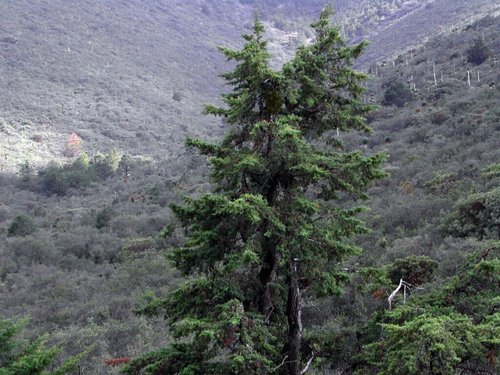


Arizona Cypress
hesperocyparis arizonica
The Arizona Cypress (Hesperocyparis arizonica) is a highly resilient, medium-sized evergreen conifer native to the rugged canyons and arid mountain slopes of the southwestern United States and northern Mexico. Known for its striking blue-green to silvery foliage, this tree naturally forms a symmetrical conical crown when young, which matures into an open, majestic, and irregular shape. It is incredibly well-adapted to harsh environments, possessing an exceptional tolerance for extreme drought, heat, and poor, rocky soils where other tree species struggle to establish themselves. In its native southwestern ecosystems, the Arizona Cypress serves an important ecological role by stabilizing vulnerable desert soil, preventing erosion on steep canyon walls, and providing year-round thermal cover and nesting sites for local desert wildlife. Often cultivated outside its native range, it has become a popular ornamental landscape choice, a reliable windbreak, and a favored Christmas tree variety.
Lebensraum: Found in dry, rocky canyons, chaparral, and pinyon-juniper woodlands at elevations ranging from 1,000 to 2,200 meters.
This evergreen conifer typically grows to a height of 10 to 25 meters, displaying a pyramidal shape in its youth. The dense foliage consists of tiny, scale-like leaves that are tightly pressed to the twigs, showcasing a beautiful glaucous blue-green, pale green, or silvery-gray color. When crushed, these leaves release a strong, pleasant, resinous aroma. The bark of the Arizona Cypress is highly distinctive, starting out smooth and reddish-brown on young branches, then maturing on the trunk into rough, fibrous, gray-brown plates that peel away to reveal cherry-red underlayers. It produces small, spherical female seed cones measuring about 2 to 3 centimeters in diameter, which transition from a dusty green to a dark, weathered brown as they mature over two years.
Kategorie
PflanzenSeltenheit
Common
Gefahr
1/5 · Sehr gering
Snaps
Mach den ersten Snap!
Because of its fast growth rate and dense, symmetrical shape when young, it is a highly popular Christmas tree choice in the southern United States.
Its durable, rot-resistant wood has historically been utilized by desert homesteaders to build sturdy fence posts.
The cones of the Arizona Cypress can cling to the tree's branches for several years before ever opening.
Many populations produce serotinous cones that remain closed on the branches for years, opening to release seeds only when triggered by the heat of a wildfire.
Features a deep taproot system and a thick, waxy cuticle coating on its scale-like leaves to significantly minimize water loss in desert climates.
Secretes sticky, aromatic resins that naturally seal wounds and defend the wood from wood-boring insects and fungal pathogens.
As a photoautotrophic plant, the Arizona Cypress synthesizes its own organic food using sunlight, carbon dioxide, water, and essential mineral nutrients absorbed from the soil.
Callophrys gryneus
The caterpillars of this butterfly feed exclusively on the scale-like foliage of cypresses and junipers.
Phoradendron bolleanum
A hemiparasitic plant that anchors into the branches of the Arizona Cypress to extract water and nutrients.
Phloeosinus cristatus
A wood-boring beetle that infests and can kill weakened or drought-stressed Arizona Cypress trees.
Für dieses Objekt sind noch keine Merkmal-Badges vergeben.
Noch keine Alternativnamen vorhanden.
Sammlungen für dieses Objekt erscheinen hier, wenn weitere Themen hinzugefügt werden.
Gefahr
1/5 · Sehr gering
Noch keine besonderen Sicherheitshinweise.
Der einfachste Weg, Arizona Cypress zu bestimmen, ist die Verwendung der Naturführer-App Snappit.
1000-2500 cm
100-200 Jahre
As a photoautotrophic plant, the Arizona Cypress synthesizes its own organic food using sunlight, carbon dioxide, water, and essential mineral nutrients absorbed from the soil.
Found in dry, rocky canyons, chaparral, and pinyon-juniper woodlands at elevations ranging from 1,000 to 2,200 meters.
Zoome hinein, um Cluster aufzulösen und zu sehen, wo dieses Objekt fotografiert wurde.
Neueste Snaps erscheinen hier, wenn neue Beobachtungen hinzukommen.

Arizona, US
Hier kann man sehen Yarrow's Spiny Lizard und Mexican Jay.
Führer anzeigen →

Arizona, US
Hier kann man sehen Mexican Jay, Yarrow's Spiny Lizard und Weißwedelhirsch.
Führer anzeigen →











