

Big Saltbush
atriplex lentiformis
Big Saltbush (Atriplex lentiformis), also known as quail bush, is a hardy, intricately branched evergreen shrub native to the arid zones of southwestern North America. It is exceptionally adapted to survival in saline, alkaline, and dry soils, acting as a critical habitat-builder in desert washes and coastal scrub ecosystems. This species plays a vital ecological role by providing nesting sites, shade, and a reliable food source for a variety of birds and small mammals.
Lebensraum: Found in arid desert valleys, alkaline flats, wash systems, and coastal sage scrub environments across southwestern North America.
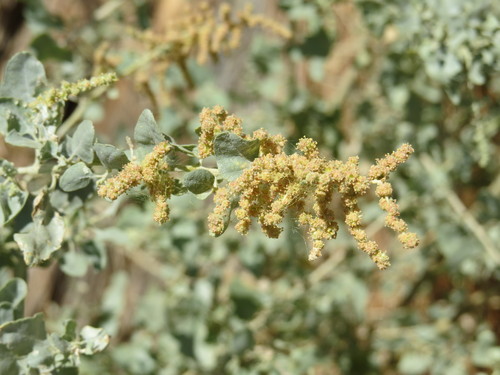
This large, sprawling shrub stands between 100 to 300 centimeters tall and features a rounded, highly branched form. Its small, ovate-to-deltoid leaves are pale grayish-green with a dusty, silvery-scurfy coating. During the summer, it bears dense, terminal clusters of small, yellowish-green flowers, followed by abundant, winged, pinkish-to-tan fruiting bracts that crowd the branch tips.
Kategorie
PflanzenSeltenheit
Common
Gefahr
1/5 · Sehr gering
Snaps
Mach den ersten Snap!
Its salty leaves can be consumed by humans either raw, cooked like spinach, or dried and ground as a savory seasoning.
The distinctive silvery sheen on the leaves is created by microscopic, salt-filled hairs that reflect intense sunlight and prevent water loss.
The plant's alternative name, quail bush, reflects its crucial role in providing shelter and food for desert quail.
Utilizes specialized leaf trichomes to isolate and pump out excess salt from its tissues, enabling survival in highly saline soils.
Uses a highly efficient metabolic pathway to fix carbon dioxide, significantly reducing water loss during hot, arid conditions.
Deploys a extensive and deep root system that anchors the plant securely in sandy desert washes and resists erosion.
As a photosynthetic plant, Big Saltbush produces its own energy using sunlight, water, carbon dioxide, and mineral nutrients absorbed from the soil.
Callipepla gambelii
Provides crucial nesting cover, shade, and nutritious seeds during the dry desert autumn.
Hesperopsis alpheus
Acts as a primary larval host plant for this specialized butterfly species.
Lepus californicus
Browses on the leaves and young shoots as an important source of moisture and nutrients in dry seasons.
Für dieses Objekt sind noch keine Merkmal-Badges vergeben.
Noch keine Alternativnamen vorhanden.
Sammlungen für dieses Objekt erscheinen hier, wenn weitere Themen hinzugefügt werden.
Gefahr
1/5 · Sehr gering
Noch keine besonderen Sicherheitshinweise.
Der einfachste Weg, Big Saltbush zu bestimmen, ist die Verwendung der Naturführer-App Snappit.
100-300 cm
10-40 Jahre
As a photosynthetic plant, Big Saltbush produces its own energy using sunlight, water, carbon dioxide, and mineral nutrients absorbed from the soil.
Found in arid desert valleys, alkaline flats, wash systems, and coastal sage scrub environments across southwestern North America.
Zoome hinein, um Cluster aufzulösen und zu sehen, wo dieses Objekt fotografiert wurde.
Neueste Snaps erscheinen hier, wenn neue Beobachtungen hinzukommen.




_7856.jpg&width=800)