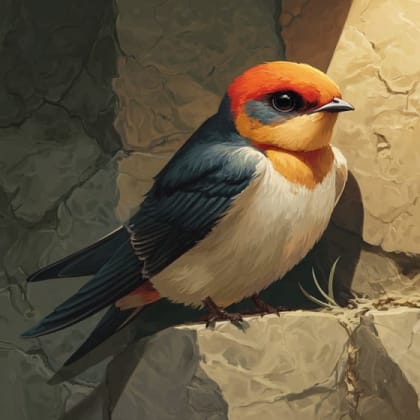
Blue-winged Kookaburra
Dacelo leachii
The Blue-winged Kookaburra is a cheerful bird known for its loud, laughing call. With bright blue wings and a friendly face, it loves to perch on trees and watch for tasty insects to eat.
Lebensraum: Forests
The Blue-winged Kookaburra has a creamy-white belly contrasted with a dark brown cap and striking sky-blue feathers on its wings. Its pale eyes give it a watchful appearance, making it distinct from other kookaburras.
Kategorie
VögelSeltenheit
Common
Gefahr
1/5 · Sehr gering
Snaps
Mach den ersten Snap!
Blue-winged Kookaburras are Australia's largest species of kingfisher.
Older siblings often help their parents raise new baby kookaburras.
Their 'laugh' is a loud territory call, not a sign of happiness!
They often bash big prey against a branch to stun it before eating!
Blue-winged Kookaburra can make a loud, cackling 'laugh' because of its unique vocal cords, used for territorial calls.
Blue-winged Kookaburra can spot tiny prey from high branches thanks to its keen eyesight, helping it hunt efficiently.
Blue-winged Kookaburra has a strong, dagger-like beak that helps it safely subdue even dangerous snakes and lizards.
These birds are hunters, eating insects, reptiles, small mammals, and even fish!
Pseudonaja textilis
preys on young venomous snakes
Mus musculus
hunts small rodents in its foraging areas
Eucalyptus camaldulensis
often nests in hollows of tall gum trees
Aquila audax
larger raptors may occasionally prey on adults
Gefiedert beschreibt Tiere, hauptsächlich Vögel, die ein Federkleid besitzen.
Soziale Tiere leben in organisierten Gruppen und kooperieren, um ihr Überleben zu sichern, beispielsweise bei der Nahrungssuche, Verteidigung und Aufzucht der Jungen.
Singende Tiere erzeugen komplexe Lautäußerungen, oft um Partner anzulocken, ihr Revier zu verteidigen oder innerhalb ihrer Art zu kommunizieren.
Farbenfroh beschreibt Organismen oder Objekte, die eine große Vielfalt an leuchtenden und deutlich erkennbaren Farben aufweisen.

Dieses Merkmal kennzeichnet Organismen, deren Nahrung hauptsächlich aus Insekten und anderen kleinen Wirbellosen besteht.

Waldlebensräume sind terrestrische Lebensräume, die von dichtem Baumbestand dominiert werden und eine große Vielfalt an Pflanzen- und Tierarten beherbergen.

Tagaktive Tiere sind hauptsächlich bei Tageslicht aktiv und ruhen oder schlafen in der Regel nachts.
Noch keine Alternativnamen vorhanden.
Gefahr
1/5 · Sehr gering
Enjoy watching birds from a distance and don’t try to touch them.
38-46 cm
64-70 cm
0.26-0.33 kg
12-15 Jahre
40 km/h
These birds are hunters, eating insects, reptiles, small mammals, and even fish!
Forests
Ambush
Zoome hinein, um Cluster aufzulösen und zu sehen, wo dieses Objekt fotografiert wurde.
Neueste Snaps erscheinen hier, wenn neue Beobachtungen hinzukommen.