

Broadleaf Milkweed
asclepias latifolia
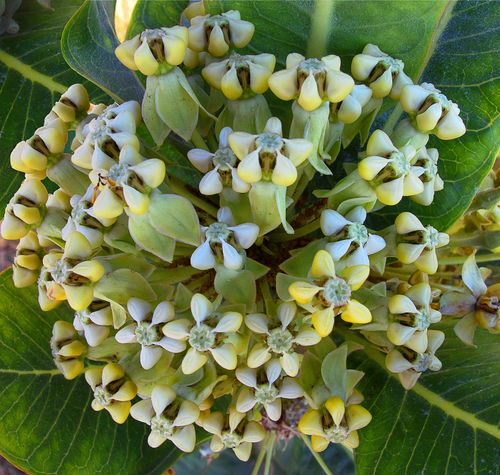
The Broadleaf Milkweed (Asclepias latifolia) is a robust and drought-resistant perennial plant native to the dry plains and desert grasslands of the central and southwestern United States. Unlike many of its delicate cousins, this milkweed features thick, tough, and exceptionally wide leaves that allow it to conserve precious moisture in arid environments. This hardy wildflower produces dense, globular clusters of yellowish-green flowers that provide an essential source of nectar for local pollinators during the hot summer months. Like other milkweeds, it produces a sticky, milky latex sap filled with toxic cardenolides, which serves as a powerful defense mechanism against herbivores while simultaneously supporting specialized insect species.
Lebensraum: Thrives in dry, open environments such as sandy prairies, desert grasslands, plains, and disturbed roadsides.
This plant is easily identified by its stout, erect stems growing 30 to 80 centimeters tall, clad in large, opposite leaves. The leaves are remarkably broad, almost circular or oval, light green to blue-green, and feel thick and leathery with prominent, pale veins. During summer, spherical clusters of small, pale green to cream-colored flowers emerge directly from the upper leaf junctions. These are followed by large, smooth, and upright seed pods containing flat seeds adorned with fluffy, white silky hairs.
Kategorie
PflanzenSeltenheit
Common
Gefahr
1/5 · Sehr gering
Snaps
Mach den ersten Snap!
Monarch caterpillars ingest the toxic sap of this plant, making themselves highly poisonous to birds and other predators.
Native Americans historically used the incredibly strong and durable fibers from the dry winter stems to craft high-quality string, ropes, and fishing nets.
The milky latex sap contains a natural rubber compound, which was briefly researched during WWII as a potential alternative rubber source.
Produces toxic cardiac glycosides within its milky sap, rendering the plant unpalatable and lethal to most mammalian and insect herbivores.
Utilizes a deep, woody taproot system to access deep groundwater reserves, enabling survival in arid and semi-desert conditions.
Seeds are attached to silky, lightweight fibers that act as miniature parachutes, allowing the wind to carry them miles away to establish new colonies.
The Broadleaf Milkweed produces its own sugars and energy through photosynthesis, utilizing sunlight, carbon dioxide, and groundwater.
Danaus plexippus
The caterpillars feed exclusively on the leaves, sequestering the plant's toxins for their own defense.
Oncopeltus fasciatus
Feeds heavily on the seed pods and concentrated juices of the plant.
Pepsis grossa
Adult wasps feed heavily on the high-energy nectar of the flowers while transferring pollen.
Für dieses Objekt sind noch keine Merkmal-Badges vergeben.
Noch keine Alternativnamen vorhanden.
Sammlungen für dieses Objekt erscheinen hier, wenn weitere Themen hinzugefügt werden.
Gefahr
1/5 · Sehr gering
Noch keine besonderen Sicherheitshinweise.
Der einfachste Weg, Broadleaf Milkweed zu bestimmen, ist die Verwendung der Naturführer-App Snappit.
30-80 cm
3-10 Jahre
The Broadleaf Milkweed produces its own sugars and energy through photosynthesis, utilizing sunlight, carbon dioxide, and groundwater.
Thrives in dry, open environments such as sandy prairies, desert grasslands, plains, and disturbed roadsides.
Zoome hinein, um Cluster aufzulösen und zu sehen, wo dieses Objekt fotografiert wurde.
Neueste Snaps erscheinen hier, wenn neue Beobachtungen hinzukommen.














