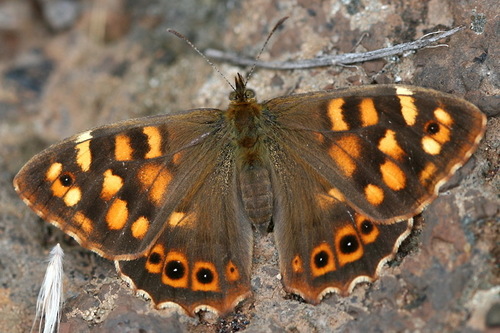


Canary Speckled Wood
pararge xiphioides
The Canary Speckled Wood, scientifically known as Pararge xiphioides, is a charming and endemic butterfly species found exclusively in the laurel and pine forests of the Canary Islands. Distinguished by its intricate speckled patterns and graceful flight, this insect plays a vital role in the island's unique ecosystem, primarily as a pollinator and a food source for various forest inhabitants. Its presence is a testament to the rich biodiversity of the archipelago, making it a focal point for nature enthusiasts and conservationists alike. What makes this butterfly particularly interesting is its adaptation to the island's diverse microclimates, often seen flitting between sunlit glades and shady undergrowth, a behavior that showcases its resilience and specialized habitat requirements.
Lebensraum: The Canary Speckled Wood is typically found in humid laurel forests, pine woodlands, and dense bushy ravines across the Canary Islands, favoring areas with dappled sunlight.
This medium-sized butterfly exhibits a distinctive mottled appearance, with wings predominantly deep brown to reddish-brown, adorned with numerous pale yellow to orange spots and ocelli (eyespots). The forewings typically feature three to four prominent black eyespots, each with a white pupil, while the hindwings display several smaller, less defined spots. The intricate patterning provides excellent camouflage amidst the dappled light of its woodland habitat. Its wingspan typically ranges from 4 to 5.5 centimeters, making it a noticeable, yet subtly colored, presence in the forest.
Kategorie
InsektenSeltenheit
Common
Gefahr
1/5 · Sehr gering
Snaps
Mach den ersten Snap!
It is a unique species closely related to the mainland European Speckled Wood, having evolved distinct characteristics in isolation on the Canary Islands.
Its 'speckled' appearance provides exceptional crypsis, allowing it to vanish against the background of dappled sunlight and shadows in its woodland habitat.
Males are well-known for their territorial behavior, engaging in elaborate aerial 'dogfights' to defend small, sunlit patches of forest floor from rival males.
Unlike many butterflies that have distinct seasonal flights, the Canary Speckled Wood can be observed flying almost year-round across the islands, thanks to the mild climate, producing multiple generations.
Its intricate wing patterns perfectly mimic the light and shadow play of the forest floor and foliage, allowing it to blend seamlessly with its environment to avoid predators.
Male Canary Speckled Woods are highly territorial, aggressively defending small sunlit patches within the forest against rivals to secure mating opportunities with females.
This butterfly employs a distinctive, seemingly random, and zig-zagging flight pattern, making it difficult for avian predators to predict its movements and capture it.
The larvae of the Canary Speckled Wood feed exclusively on various types of grasses, while adult butterflies primarily consume nectar from flowering plants, honeydew, and occasionally tree sap for energy.
Altersunterschiede: Larvae are strictly graminivorous (grass-eaters), whereas adults are nectivorous and saprophagous.
Brachypodium sylvaticum
Primary larval food source in Canary Islands woodlands.
Rubus fruticosus
Adults frequently feed on nectar from its flowers.
Cyanistes teneriffae
A common avian predator in its habitat.
Araneus diadematus
A generalist predator that may capture butterflies in webs.
Für dieses Objekt sind noch keine Merkmal-Badges vergeben.
Noch keine Alternativnamen vorhanden.
Sammlungen für dieses Objekt erscheinen hier, wenn weitere Themen hinzugefügt werden.
Gefahr
1/5 · Sehr gering
Noch keine besonderen Sicherheitshinweise.
Der einfachste Weg, Canary Speckled Wood zu bestimmen, ist die Verwendung der Naturführer-App Snappit.
1-2 cm
4-5 cm
0.0005-0.001 kg
0 Jahre
10 km/h
The larvae of the Canary Speckled Wood feed exclusively on various types of grasses, while adult butterflies primarily consume nectar from flowering plants, honeydew, and occasionally tree sap for energy.
The Canary Speckled Wood is typically found in humid laurel forests, pine woodlands, and dense bushy ravines across the Canary Islands, favoring areas with dappled sunlight.
Zoome hinein, um Cluster aufzulösen und zu sehen, wo dieses Objekt fotografiert wurde.
Neueste Snaps erscheinen hier, wenn neue Beobachtungen hinzukommen.




.jpg&width=800)










.jpg&width=800)


.jpg&width=800)

