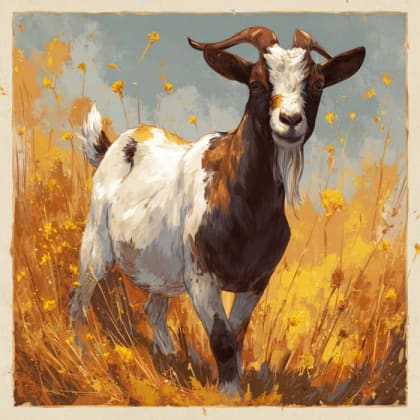
Capra Aegagrus Hircus
capra aegagrus hircus
The Capra Aegagrus Hircus, also known as the domestic goat, is a friendly and curious animal! They love to explore their surroundings and are known for their playful nature.
Lebensraum: Domestic goats can be found on farms, in backyards, and sometimes in the wild in mountainous areas.
The Capra Aegagrus Hircus is a medium-sized ungulate with varying coat colors from white, brown, black, to spotted patterns. They often have distinctive beards, horns that can be curved or spiral, and elongated pupils. Their cloven hooves are built for agility on uneven terrain.
Kategorie
SäugetiereSeltenheit
Common
Gefahr
1/5 · Sehr gering
Snaps
Mach den ersten Snap!
A group of goats is sometimes called a "trip" or a "flock."
Baby goats, called kids, start nibbling solid food within days of birth!
Goats have rectangular pupils, giving them nearly 360-degree vision!
Goats were one of the first animals to be domesticated by humans!
Capra Aegagrus Hircus can scale steep, rocky terrains because of their specialized cloven hooves that provide exceptional grip.
Capra Aegagrus Hircus has a four-chambered stomach that helps them digest tough plant materials, extracting nutrients efficiently.
Capra Aegagrus Hircus possesses incredible balance that allows them to navigate narrow ledges and precarious perches with ease.
These clever eaters graze on many plants, helping to keep landscapes tidy!
Homo sapiens
Humans provide shelter and food for goats.
Canis lupus
Wild wolf packs may prey on domestic goats.
Aquila chrysaetos
Golden eagles are known to prey on young goat kids.
Pelzig beschreibt Tiere, die eine dichte Schicht aus weichen Haaren oder Fell besitzen.
Soziale Tiere leben in organisierten Gruppen und kooperieren, um ihr Überleben zu sichern, beispielsweise bei der Nahrungssuche, Verteidigung und Aufzucht der Jungen.
Grasland-Lebensräume sind terrestrische Biome, die von Gräsern und krautigen Pflanzen dominiert werden und einer Vielzahl von Weidetieren als Lebensraum dienen.
Dieses Merkmal kennzeichnet Lebewesen, deren Ernährung vollständig oder hauptsächlich aus pflanzlichem Material besteht.
Gefahr
1/5 · Sehr gering
Always approach animals gently and ask an adult for help.
100-180 cm
20-140 kg
10-18 Jahre
25 km/h
These clever eaters graze on many plants, helping to keep landscapes tidy!
Domestic goats can be found on farms, in backyards, and sometimes in the wild in mountainous areas.
Grazing
1-3
Zoome hinein, um Cluster aufzulösen und zu sehen, wo dieses Objekt fotografiert wurde.
Neueste Snaps erscheinen hier, wenn neue Beobachtungen hinzukommen.